
A gun collection often grows quietly over years of purchases, trades, and inheritances until one day the owner realizes it’s worth far more than a standard homeowners policy was ever designed to protect. Firearms insurance addresses that gap, and it covers more ground than most people expect: property protection for the collection itself, liability coverage tied to firearm-related claims, and documentation requirements that make a claim go smoothly instead of getting stuck in dispute.
This guide focuses on personal firearms insurance for collectors and high-value households, not firearms businesses or instructors. It covers what firearms insurance can mean, whether homeowners insurance already covers guns, how to document a collection properly, and what to review before requesting a quote.
What Is Firearms Insurance?
Firearms insurance can refer to several different coverage needs, and it helps to know which one applies to your situation before shopping for a policy. This article focuses primarily on personal firearms insurance for collectors and high-value households, not commercial or instructor coverage.
Firearms insurance may involve:
-
Homeowners or renters personal property coverage
-
Scheduled personal property
-
Valuable articles coverage
-
Collectibles insurance
-
Stand-alone gun collection insurance
-
Personal firearms liability insurance
-
Umbrella liability review
-
Business or instructor coverage, if applicable
Collector firearms coverage is different from firearms instructor insurance, firearms business insurance, gun range insurance, and firearms manufacturer insurance. If you sell, teach, repair, or operate a range alongside your personal collection, that activity typically needs its own commercial policy rather than an extension of your personal coverage. A gun collection often sits alongside other high-value assets, and reviewing it as part of a broader insurance for high-value collections strategy tends to produce better results than treating it as an isolated line item.
Does Homeowners Insurance Cover Firearms?
Homeowners insurance may provide some coverage for firearms as personal property, but valuable gun collections can run into policy limits, theft sublimits, exclusions, documentation issues, or valuation disputes.
A few things worth knowing before assuming your existing policy has you covered:
-
Firearms may be treated as personal property under some policies.
-
Theft limits or special sublimits may apply, and these are often lower than collectors expect.
-
High-value firearms may need scheduled coverage rather than relying on the base policy limit.
-
Antique or collectible firearms may need appraisal documentation to support their value.
-
Accessories, optics, cases, safes, or related property may not be treated the same way as the firearms themselves.
-
Liability related to firearms may be limited or excluded entirely.
-
Coverage depends on policy language and state-specific rules, which vary carrier by carrier.
Homeowners insurance does not always cover firearms the way owners assume, and this is worth confirming directly rather than guessing. Many carriers offer special coverage for valuables through a floater or endorsement once a collection outgrows the base policy’s sublimits, which is often the more practical fix than trying to stretch standard coverage further. For collectors with meaningful equity in their homes and their collections, it’s worth reviewing this alongside broader high-value home insurance in Florida coverage, since sublimits on one policy can create blind spots that only show up after a loss.
If your firearm collection has grown beyond ordinary personal property limits, Harbour Insurance can help you review whether your current homeowners policy gives your collection the protection it needs.
How Do I Insure a Gun Collection?
To insure a gun collection, create a detailed inventory, document serial numbers and values, photograph each item, review your homeowners policy limits, ask about scheduled personal property or collectibles coverage, and confirm how the policy handles theft, fire, damage, storage, transit, and liability.
1. Create a Detailed Firearms Inventory
A solid firearm inventory should include the manufacturer, importer (if applicable), model, serial number, type, and caliber or gauge for each piece. Add the date acquired, purchase price, current estimated value, and purchase location, along with photos, receipts, appraisal records, and any transfer or inheritance documentation. Note the storage location and any accessories tied to each firearm.
This inventory should be stored securely and separately from the firearms themselves. It’s not a good idea to publish, email, or casually share a full list of serial numbers; treat that record with the same care you’d give any sensitive financial document. The ATF’s Personal Firearms Record offers a useful template for organizing this information.
2. Estimate the Collection’s Current Value
Purchase price rarely matches replacement value, especially for antique firearms, historic pieces, rare models, limited-production runs, engraved or customized firearms, and inherited pieces with provenance. Many of these appreciate well beyond their original cost. Collectors may need appraisals, comparable sales data, purchase receipts, or specialist valuations to establish an accurate current value for insurance purposes.
3. Review Homeowners or Renters Insurance Limits
Before assuming coverage is adequate, ask your carrier or advisor:
-
Are firearms covered as personal property?
-
Is theft covered, and is there a special theft sublimit for firearms?
-
Are antique or collectible firearms treated differently?
-
Are accessories, optics, cases, or safes covered?
-
Are off-premises or in-transit firearms covered, including during a move?
-
Are flood, hurricane, or water damage losses excluded?
-
Is liability related to firearms limited or excluded?
4. Ask About Scheduled or Blanket Collection Coverage
Scheduled coverage lists individual high-value firearms separately with specific values attached to each. Blanket collection coverage applies a broader limit to the full collection without listing every item separately, depending on how the policy is structured. For larger or particularly valuable collections, a stand-alone collection policy may be worth considering rather than trying to fit everything under a homeowners endorsement.
5. Review Liability Separately
Property coverage protects the collection as an asset. Liability coverage addresses injury or property damage claims. These are not the same thing, and one doesn’t substitute for the other. Ask about personal liability, umbrella liability, intentional act exclusions, negligent storage allegations, guest or household exposure, and whether instructor, business, range, or commercial activity is excluded from your personal policy.
What Can Firearms Insurance Cover?

Firearms Insurance for Collectors
Collectors generally need more careful coverage than someone who owns one or two ordinary household firearms. Antique firearms, historic pieces, rare models, inherited guns, firearms with provenance, engraved or custom pieces, and limited-production items each carry valuation and documentation questions that a standard homeowners policy was never built to answer.
Collections stored in safes, vaults, or dedicated rooms, or split across multiple properties, add another layer of complexity. So does transporting pieces for appraisal, sale, exhibition, or relocation. Documentation and privacy matter throughout this process, since detailed records support a claim but shouldn’t be handled carelessly.
The best firearms insurance for collectors is not simply the cheapest policy available. It should match the collection’s value, documentation, storage, risk profile, and liability exposure, which is why it helps to review options through the lens of best collectibles insurance companies rather than price alone.
Firearms Property Insurance vs. Firearms Liability Insurance
Firearms property insurance protects the financial value of the firearm collection against covered losses such as theft, fire, or accidental damage, depending on policy wording.
Firearms liability insurance addresses certain liability claims involving injury or property damage, depending on policy terms and exclusions.

What May Not Be Covered Automatically?
Exclusions and restrictions vary by carrier, but collectors should ask specifically about how the following are treated: theft sublimits, unscheduled high-value firearms, firearms without documentation, off-premises losses, and transit losses. Flood damage, hurricane or storm surge damage, water damage exclusions, and corrosion, rust, or gradual deterioration are also worth confirming, along with wear and tear, mechanical breakdown, and custom modifications.
A few other gaps show up often: accessories not listed on the policy, ammunition, illegal possession or transfer, business use, instructor use, gun range activity, and firearms held for sale. Self-storage facilities, inherited firearms with unclear documentation, intentional acts, criminal acts, and liability exclusions round out the list, along with a straightforward one that trips people up more than it should: failure to comply with the storage or policy conditions the carrier required at binding.
How Much Does Firearms Insurance Cost?
Firearms insurance cost depends on the value of the collection, number of firearms, coverage type, storage, location, documentation, deductible, policy limits, and whether liability coverage is included. There isn’t a reliable fixed number to quote here; the honest answer is that pricing should come from a carrier reviewing the specific collection.

How to Document a Firearms Collection for Insurance
Good documentation is what turns a smooth claim into reality instead of a drawn-out dispute. Start a secure digital and physical inventory, recording the manufacturer, model, serial number, caliber or gauge, type, acquisition date, and cost for each item. Photograph each firearm clearly, along with distinguishing features, engraving, accessories, and any related documentation.
Save receipts, bills of sale, appraisals, and provenance records as you acquire them, and update the inventory after every purchase, sale, transfer, or inheritance. Keep insurance documents and inventory records separate from the firearms themselves, and store copies securely and privately. Ask your insurance advisor exactly what documentation is required for any items you plan to schedule individually. The NAIC’s guidance on building a home inventory is a helpful starting point for the broader process.
A well-documented collection is easier to insure and easier to support during a claim. Harbour Insurance can help you evaluate whether scheduled coverage, blanket collectibles coverage, or broader private client protection makes sense.
Safe Storage, Theft Risk, and Insurance
This section stays focused on risk management and property protection, not firearm handling. Underwriters and claims adjusters generally want to know about locked safes or vaults, alarm systems, monitored security, and cameras. Fire protection, water and humidity concerns, and restricted access all factor in as well.
Store documentation separately from the collection, and think through the safe location within the home relative to fire and flood exposure. If the collection is split across multiple residences, each location needs its own review, including seasonal or vacant home risks, transport and temporary storage, and Florida hurricane preparation.
Florida Considerations for Firearm Collectors
Florida collectors face a distinct set of risks tied to weather and seasonal living. Hurricane exposure, flood and storm surge risk, wind-driven rain, and water intrusion can all threaten a collection even when it’s stored well away from a window. Humidity and corrosion are a quieter but persistent concern for anyone storing firearms in a coastal climate long-term.
Theft risk tends to rise after disasters, when homes may sit vacant or damaged. Seasonal residents, collections stored across multiple homes, and high-value homes with dedicated collection rooms or safes all deserve their own review, along with evacuation planning and storage arrangements during extended travel.
Firearms insurance does not automatically cover flood, hurricane, or storage-related damage just because the collection is in Florida. Collectors should review how the firearms policy, homeowners policy, flood policy, and valuables coverage work together, and this ties directly into broader decisions like homeowners insurance in Florida without hurricane coverage and high-value home insurance in Florida.
Inherited Firearms and Insurance
Inherited firearms often create extra documentation and valuation questions on top of the usual coverage decisions. Start by confirming ownership documentation and recording serial numbers and descriptions for each piece. Check applicable federal, state, and local requirements, and keep legal compliance separate from insurance coverage; these are related but distinct concerns.
Get appraisals for collectible or historic items, and review whether the collection should be scheduled individually once you know its value. Update your home inventory accordingly, and review storage, transport, and transfer questions with qualified legal or compliance professionals rather than relying on general advice. This article isn’t a substitute for that guidance.
Firearms Insurance for High-Net-Worth Households
A firearm collection often sits alongside other valuable assets: art, jewelry, watches, wine, collectibles, classic and exotic cars, yachts, multiple homes, private aircraft, and equestrian assets. Add umbrella liability, domestic staff, and family office planning, and it becomes clear why firearms insurance rarely works well as a standalone decision for these households.
A private client advisor can help coordinate firearms insurance with broader valuable articles coverage, high-value home insurance, flood insurance, umbrella liability, and overall risk management for high-net-worth individuals. This coordination matters more as the rest of the estate grows, and it’s a core part of how types of insurance for high-net-worth individuals programs are typically built, alongside ultra-high-net-worth insurance planning for the largest collections and estates.
What to Prepare Before Getting a Firearms Insurance Quote
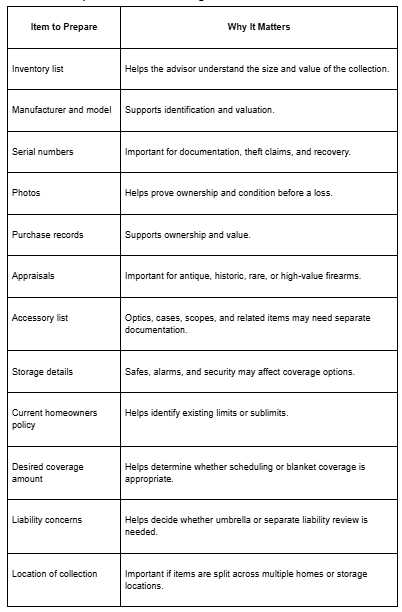
Questions to Ask Before Buying Firearms Insurance
-
Does my homeowners policy cover firearms?
-
Is there a theft sublimit for firearms?
-
Does my policy cover antique or collectible firearms?
-
Should high-value firearms be scheduled individually?
-
Is blanket collection coverage available?
-
Are accessories, scopes, optics, and cases covered?
-
Is accidental damage covered?
-
Is off-premises coverage included?
-
Are firearms covered during transport?
-
Is flood damage excluded?
-
How are hurricane-related losses treated?
-
Does coverage apply to inherited firearms?
-
What appraisal documentation is required?
-
How should serial numbers be documented?
-
Does my personal liability coverage apply to firearm-related claims?
-
Does my umbrella policy exclude firearms-related incidents?
-
Do instructor, business, or range activities require separate coverage?
-
What claim documentation would be required after theft or damage?
Why Work With a Private Client Insurance Advisor?
Firearms insurance can involve personal property, collectibles, liability, legal compliance questions, storage risk, and high-value household planning all at once, which is a lot to sort through alone. A private client insurance advisor can review your homeowners and valuables limits, identify firearms sublimits, and help decide whether to schedule individual items or rely on blanket collection coverage.
From there, an advisor can coordinate collectibles coverage more broadly, review umbrella liability, and address Florida storm and flood exposure across multiple homes if needed. Just as important, a good advisor helps you document the collection properly and close the gap that often opens between property coverage and liability coverage. This kind of coordination extends naturally to other valuables in the same household, including insurance for high-value collections, art insurance cost considerations, and wine collection insurance.
Own antique, historic, inherited, or high-value firearms? Contact Harbour Insurance to review firearms insurance options and identify gaps before theft, damage, or liability issues occur.
Frequently Asked Questions
How do I insure a gun collection?
To insure a gun collection, create a detailed inventory, photograph each firearm, record serial numbers, document values, review your homeowners policy, and ask whether scheduled personal property, collectibles coverage, or a stand-alone firearms insurance policy is appropriate.
Does homeowners insurance cover firearms?
Homeowners insurance may provide limited coverage for firearms as personal property, but sublimits, exclusions, and documentation requirements may apply. Valuable or collectible firearms may need scheduled coverage or a separate collectibles policy.
What is firearms insurance for collectors?
Firearms insurance for collectors is coverage designed to protect valuable, rare, antique, historic, or inherited firearms against covered losses. It may involve scheduled coverage, blanket collection coverage, or a stand-alone collectibles policy.
Does firearms insurance cover theft?
Firearms insurance may cover theft if theft is included under the policy and the collection is properly documented. Collectors should ask about theft sublimits, storage requirements, off-premises losses, and claim documentation.
Do I need an appraisal for a gun collection?
An appraisal may be needed for antique, rare, historic, inherited, or high-value firearms. Even when an appraisal is not required, photos, receipts, serial numbers, and inventory records can help support coverage limits and claims.
Are firearm accessories covered by insurance?
Accessories such as optics, scopes, cases, and related equipment may or may not be covered under the same terms as the firearms. Collectors should document accessories separately and ask whether they need to be scheduled.
Does umbrella insurance cover firearms liability?
Umbrella coverage may have exclusions or limitations related to firearms, intentional acts, criminal acts, or business use. Collectors should review policy wording with an advisor instead of assuming umbrella coverage applies.
Is gun collection insurance different from firearms liability insurance?
Yes. Gun collection insurance focuses on protecting the value of the firearms as property. Firearms liability insurance focuses on claims involving injury or property damage. Collectors may need to review both.




