

TL;DR: The best collectibles insurance companies offer agreed-value coverage, worldwide protection, low or no deductible options, and flexible scheduling for collections that span multiple categories and locations. Standard homeowners policies cap collectibles coverage at levels that are meaningfully inadequate for serious collectors, making specialist coverage the only structure that reflects what a high-value collection is actually worth. The right carrier depends on what you collect, how you store it, and whether your collection is actively growing or moving through transit and exhibition.
Get your collection covered correctly. Compare collectibles insurance companies |Request high value collection coverage |Speak with a collectibles insurance advisor
Most collectors discover the limits of their homeowners policy at exactly the wrong moment: after a loss. A standard homeowners policy might offer $2,500 to $5,000 in scheduled jewelry coverage and a blanket sub-limit on collectibles that doesn’t come close to covering a serious collection of sports cards, fine art, rare coins, or vintage wine. The gap between what you own and what your policy would pay is where the best collectibles insurance earns its premium.
Specialist collectibles coverage exists to close that gap precisely, with coverage terms built around how collections actually behave: they appreciate, they travel, they’re loaned to exhibitions, and they carry value that no depreciation schedule can capture accurately.
What Is Collectibles Insurance?
Collectibles insurance is specialized coverage for high-value personal collections that standard homeowners policies handle inadequately. It’s designed around the specific risk profile of objects that appreciate over time, require careful handling, and are often transported, exhibited, loaned, or stored in facilities separate from the owner’s primary residence.
Collections that commonly require specialist coverage include:
-
Fine art and sculpture, including paintings, prints, photographs, and installation works
-
Sports cards and trading cards, where individual cards can now carry six and seven-figure values
-
Rare coins and currency, where agreed value at appraisal is essential given the precision of numismatic grading
-
Comic books and original art, including graded slabs and original publication artwork
-
Memorabilia, including signed items, game-used equipment, and historical artifacts
-
Wine and spirits collections, where storage conditions, transit exposure, and temperature events all create specific risks
-
Luxury watches and jewelry, particularly pieces not adequately covered under standard homeowners scheduled limits
-
Antiques and decorative arts, including furniture, ceramics, silver, and period objects
Is Collectibles Insurance Worth It?
For any collection with meaningful aggregate value, yes. Standard homeowners policies typically impose sub-limits on collectibles categories, often $1,000 to $2,500 per item or $5,000 to $10,000 in aggregate, that are structurally inadequate for serious collectors. A single graded PSA 10 rookie card, a case of first-growth Bordeaux, or a bronze sculpture can exceed those limits individually. Specialist coverage removes those sub-limits and replaces them with agreed-value protection calibrated to what the collection actually contains.
What the Best Collectibles Insurance Companies Offer
The features that separate specialist collectibles coverage from standard homeowners riders are consistent across the top carriers, and they matter in specific ways at claims time.
-
Agreed value coverage sets the payout amount at policy inception based on current appraisal or documented value. There is no depreciation, no negotiation, and no dispute about what the item was worth. If a total loss occurs, you receive the agreed amount. For appreciating collectibles, this is the only valuation structure that makes financial sense.
-
Worldwide protection covers the collection wherever it is: at home, in transit, at an auction house, on loan to a museum, or in storage at a separate facility. Standard homeowners policies are largely property-specific and don’t follow objects in transit or exhibition.
-
Low or no deductible options are available through most specialist carriers for scheduled collections. On high-value items, even a modest deductible represents meaningful out-of-pocket exposure. Many specialist programs offer zero-deductible options for collections above certain value thresholds.
-
Automatic coverage for new acquisitions provides a grace period, typically 30 to 90 days, during which newly purchased items are covered under the existing policy before formal scheduling. For active collectors, this prevents gaps between purchase and documentation.
-
Restoration coverage addresses the cost of professional conservation or restoration following a covered loss, which for fine art, antiques, and rare objects can be the most appropriate response to damage rather than full replacement.
-
Flexible storage requirements recognize that collections are often stored in multiple locations: a primary residence, a secondary home, a climate-controlled storage facility, or a gallery. Specialist policies cover items across all documented storage locations rather than restricting coverage to a single address.
Best Collectibles Insurance Companies
The specialist collectibles insurance market includes dedicated collector carriers alongside the private client programs of major high-net-worth insurers. An independent advisor compares these options based on your specific collection type, value, storage, and usage rather than presenting a single carrier as the default answer.
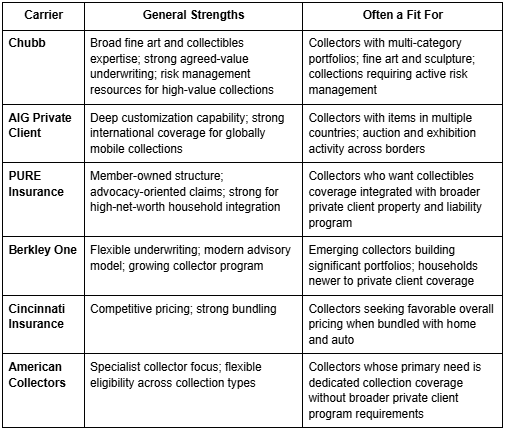
This is not a confirmed list of agency appointments. Harbour Insurance helps clients compare collectibles insurance carriers and build customized coverage packages based on collection type, value, and usage.
Ready to compare your options?Compare collectibles insurance carriers |Request a collection insurance quote
What Collectibles Insurance Covers
A well-structured specialist policy covers the full range of risks that a serious collection faces across its lifetime of ownership, exhibition, and transfer.
Physical loss and damage from fire, theft, accidental breakage, water damage, and vandalism. Unlike standard homeowners coverage, specialist policies typically cover mysterious disappearance, meaning an item that cannot be found or accounted for, which matters for portable items like watches, coins, and cards.
Transit and shipping covering items in transit between locations, whether shipped by courier, transported personally, or moved by a professional art handler. Transit is one of the highest-risk moments in a collection’s lifecycle, and standard policies often exclude or severely limit coverage during movement.
Exhibition and loan covering items while on loan to museums, galleries, auction houses, or other institutions. Items on exhibition typically leave the owner’s direct custody, and standard policies often don’t follow them out the door.
Storage at off-site facilities covering items in climate-controlled storage, gallery facilities, or conservation studios that are separate from the insured’s primary residence.
Specific collection categories the best collectibles insurance addresses:
Fine art, sports and trading cards, rare coins and currency, comic books and graded collectibles, memorabilia and historical artifacts, wine and spirits, luxury watches, jewelry, and antiques and decorative arts.
How to Compare Collectibles Insurance Providers
Not all specialist policies are structured the same way, and the differences become material when a claim occurs. These are the comparison points that matter most.
Coverage Limits
The limit needs to reflect the current aggregate appraised value of the collection, not a round number selected at inception and never reviewed. Collections that appreciate meaningfully should be reappraised at regular intervals, and coverage limits updated to match. An item insured at $50,000 that’s now worth $150,000 is functionally two-thirds uninsured.
Agreed Value Coverage
Confirm explicitly that the policy pays agreed value at total loss, not stated value or actual cash value. Stated value policies pay the lesser of the stated value or actual cash value, which introduces depreciation risk. Agreed value means what it says: the amount agreed at policy inception is what you receive, unconditionally.
Deductibles
Ask about zero-deductible options for scheduled collections. Many specialist carriers offer this for high-value items, and the premium differential is often modest relative to the out-of-pocket exposure a deductible creates on a valuable piece.
Worldwide Protection
Confirm that coverage follows the items, not the address. Specifically ask about transit coverage, exhibition coverage, and coverage while items are in the custody of third parties such as auction houses, conservators, and galleries.
Appraisal Requirements
Understand what documentation the carrier requires to schedule items and what their appraisal currency requirements are. Some carriers accept recent purchase receipts for newly acquired items; others require independent appraisals.Contact Harbour to understand appraisal requirements across the carriers they work with before you begin the scheduling process.
Agreed Value Collectibles Insurance Explained
Agreed value is the coverage structure that makes specialist collectibles insurance meaningfully different from a standard homeowners rider. Here’s how it works in practice.
At policy inception, you and the carrier agree on the value of each scheduled item, supported by appraisal documentation, recent comparable sales, or purchase receipts. That agreed value becomes the contractual payout amount in the event of a total loss. There is no depreciation applied, no post-loss negotiation, and no market survey to determine what the carrier thinks the item was worth at the time of loss.
For collectibles that appreciate, this structure is financially critical. A painting purchased for $80,000 and appraised at $200,000 five years later needs to be scheduled at $200,000 to be protected at $200,000. If the agreed value hasn’t been updated to reflect current market value, the difference between what you’re insured for and what the item is worth is a loss you absorb personally.
This is why regular reappraisal matters as much as having the right policy structure. The best collectibles insurance companies work with collectors to keep scheduled values current, often requiring reappraisal every three to five years for items in categories with active appreciation.
Do Collectibles Insurance Companies Require Appraisals?
Requirements vary by carrier and by item value, but the general framework is consistent across the specialist market.
-
High-value individual items almost always require a formal independent appraisal from a qualified specialist in that category. For fine art, this means an appraiser with recognized credentials in the relevant category. For coins, a certification from a recognized grading service. For wine, current market documentation from a specialist retailer or auction record.
-
Blanket coverage for collections below a certain per-item threshold may not require individual appraisals, covering the aggregate collection up to a total limit without scheduling each item separately. This is practical for large collections of lower-value items but provides less precision at claims time.
-
Scheduled coverage for individual high-value items requires documentation that supports the agreed value: appraisal reports, auction records, dealer invoices, or grading certificates. The quality of documentation directly affects how smoothly a claim resolves.
For newly acquired items, most specialist carriers offer an automatic coverage grace period of 30 to 90 days during which the item is covered while appraisal and scheduling are arranged. Active collectors should confirm this grace period with their advisor and ensure newly acquired significant pieces are formally scheduled before that window closes.
How Much Does Collectibles Insurance Cost?
Collectibles insurance typically costs between $1 and $3 per $1,000 of insured value annually, making it one of the more cost-efficient forms of asset protection available relative to the value being protected.
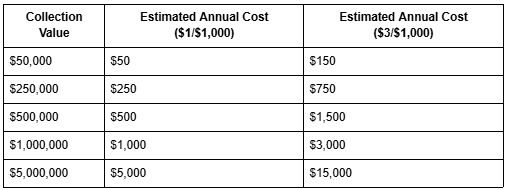
The factors that move premiums within that range include collection value and composition, storage type and security, location and transit frequency, deductible selection, and whether coverage is blanket or fully scheduled. Collections stored in professional climate-controlled facilities with monitored security attract better pricing than equivalent collections in residential storage without dedicated security. Request a quote to get a specific number for your collection’s profile.
Worldwide Coverage for Collectibles
For collectors whose items travel, worldwide protection is a non-negotiable coverage feature rather than an optional add-on. The best collectibles insurance companies include worldwide coverage as standard in specialist policies, addressing the specific exposures that arise when items leave the primary storage location.
Transit coverage protects items while being shipped, couriered, or personally transported between locations. This is one of the highest-risk periods for a collectible, particularly for fragile items, and coverage should address both carrier liability gaps and the full agreed value of the item in transit.
Exhibition coverage protects items on loan to museums, galleries, and institutions where the item is in third-party custody and subject to handling by people outside the owner’s direct control.
Shipping coverage specifically addresses the exposure during commercial shipping, including packaging, loading, and unloading events that can cause damage not attributable to the carrier.
Travel protection covers items that accompany the collector during personal travel, including watches, jewelry, and portable collectibles that are worn or carried rather than shipped.
What Coverage Should Collectors Choose?
The right coverage structure depends on the composition of the collection, the value distribution across items, and how the collection is managed and used.
-
Scheduled coverage for individual high-value items is the appropriate structure when the collection includes pieces with significant individual values. Each item is scheduled at its agreed value with supporting documentation. This provides the most precise protection and the clearest claims process, but requires active maintenance as values change and new items are acquired.
-
Blanket coverage for collections where value is distributed across many lower-value items provides aggregate coverage up to a total limit without scheduling each piece individually. This is practical for large accumulations of trading cards, coins, or similar items where individual scheduling would be impractical, but provides less certainty at claims time for higher-value individual pieces.
-
Worldwide coverage should be confirmed as standard rather than assumed. Verify specifically that transit, exhibition, and third-party custody exposures are addressed.
-
Agreed value coverage should be the default structure for any item or collection with meaningful value. The alternative structures, stated value and actual cash value, introduce depreciation risk that is inconsistent with the nature of appreciating collectibles.
Ready to build your coverage package?Build a custom collectibles insurance package |Compare high value collection coverage
Who Needs Collectibles Insurance?
The practical answer is anyone whose collection has grown beyond what their homeowners policy sub-limits can cover. More specifically:
Serious collectors who have invested meaningfully in a single category or across multiple categories and whose aggregate collection value exceeds the homeowners policy sub-limits that apply to collectibles.
Investors in collectibles who are acquiring items as appreciating assets and need coverage that reflects current market value rather than depreciated actual cash value.
Dealers and consignors who hold inventory or consigned items in their custody and need coverage that addresses the specific risks of items owned by third parties in their care.
High-net-worth households for whom collectibles represent one component of a broader asset portfolio that includes art, jewelry, wine, and other scheduled valuables alongside real estate and financial assets.
If your collection has reached a point where a significant loss would have real financial consequences, specialist coverage is the appropriate response.Contact Harbour to review your current coverage and identify where gaps exist relative to what your collection is actually worth today.
The Right Coverage for What You’ve Collected
The best collectibles insurance isn’t a single carrier. It’s the combination of agreed-value coverage, worldwide protection, appropriate scheduling, and a carrier whose underwriting reflects the specific categories you collect. That combination looks different for a fine art collector, a serious sports card investor, and a wine collector with a temperature-controlled cellar, which is why comparing options through an independent advisor produces better outcomes than selecting a carrier based on name recognition alone.
Compare collectibles insurance companies to find the right fit for your collection, or request high value collection coverage through Harbour’s independent advisors.
FAQ
What is the best collectibles insurance company?
There isn’t a single answer. The right carrier depends on what you collect, how it’s stored, whether items travel or go on exhibition, and whether you want collectibles coverage integrated with a broader private client program or as a standalone policy. Specialist carriers including Chubb, AIG Private Client, PURE, Berkley One, American Collectors, and Cincinnati Insurance each have strengths in different collection categories and ownership profiles.
Which insurers cover collectibles?
Private client carriers and specialist collector insurers are the primary options. Standard homeowners carriers typically impose sub-limits that make them inadequate for serious collections. Specialist coverage is available through independent advisors who compare options across multiple carriers.
Is collectibles insurance worth it?
For any collection where the aggregate value meaningfully exceeds the sub-limits in your homeowners policy, yes. The cost of specialist coverage is typically $1 to $3 per $1,000 of insured value annually, which is modest relative to the agreed-value protection it provides for appreciating assets.
How much does collectibles insurance cost?
Typically $1 to $3 per $1,000 of insured value per year, depending on collection type, storage, security, location, and deductible selection. A $500,000 collection might cost $500 to $1,500 annually to insure under a specialist policy.
Do insurers require appraisals for collectibles?
For high-value individual items, yes. Most specialist carriers require independent appraisals or grading certifications to support the agreed value for scheduled items. Blanket coverage for lower-value collections may not require individual appraisals. Appraisal requirements and frequency vary by carrier.
Is collectibles insurance coverage worldwide?
Most specialist policies include worldwide coverage as standard, protecting items at home, in transit, at exhibitions, and in third-party custody. Confirm specifically with your advisor that transit, shipping, and exhibition exposures are covered before assuming worldwide protection applies.
What is agreed value collectibles insurance?
It’s a coverage structure where you and the carrier agree on the value of each insured item at policy inception. That agreed amount is what you receive at total loss, with no depreciation applied and no post-loss negotiation. It’s the only valuation structure that makes sense for collectibles that appreciate over time.




