
Yacht brokerage operates at the intersection of high-value assets, complex transactions, and clients with significant expectations. A single contract error, a miscommunicated survey finding, or a dispute over vessel condition can generate claims that dwarf the commission earned on the deal. In an industry where transactions routinely involve six, seven, or eight figures, the financial exposure from even a minor professional mistake can be career-ending without proper insurance.
Think of yacht broker insurance the way a surgeon thinks about malpractice coverage: the work itself is specialized and high-stakes, the consequences of error are disproportionate to the act, and operating without protection isn’t a viable option regardless of how careful you are.
Key Takeaways:
-
Yacht broker insurance typically includes errors and omissions (E&O), general liability, and cyber coverage, forming the foundation of professional protection in marine brokerage.
-
Costs vary based on deal size, annual revenue, and claims history, ranging from approximately $1,500 per year for small independents to $15,000+ for high-volume firms.
-
Professional liability (E&O) is the most critical coverage type, protecting against financial losses caused by advisory mistakes, contract errors, or misrepresentation claims.
-
Specialized marine insurers offer significantly better protection than general commercial providers because they understand the specific risks yacht brokers face.
Request a tailored yacht broker insurance quote through Harbour Insurance Agency.
What Insurance Does a Yacht Broker Need
Yacht brokers need insurance that reflects both the advisory nature of the work and the operational risks that come with handling high-value transactions. Because broker liability can arise from professional guidance, client interactions, data handling, and day-to-day business activity, the right coverage usually involves a combination of policies rather than a single standalone form.
Core Coverage Types
Professional liability (errors and omissions). The cornerstone of yacht broker insurance. E&O protects against claims arising from professional mistakes, omissions, or alleged negligence in advisory services. If a client alleges that your misrepresentation of a vessel’s condition, a contract drafting error, or an incorrect valuation caused them financial harm, E&O responds with both legal defense and settlement or judgment payments.
General liability. Covers bodily injury and property damage from third parties. If a client is injured visiting your office, if property is damaged during a sea trial you arranged, or if a third party suffers harm connected to your business operations, general liability provides the protection.
Cyber liability and data breach coverage. Yacht brokers handle sensitive client information, including financial records, personal details, and sometimes banking information for escrow transactions. A data breach, ransomware attack, or email compromise can expose client data and trigger notification requirements, regulatory fines, and liability claims that a standard E&O policy won’t cover.
Business property (if applicable). If you maintain a physical office with equipment, inventory, or business property, standard commercial property coverage protects against fire, theft, weather damage, and other perils.
What Does Yacht Broker Insurance Cover
Yacht broker insurance is designed to respond to the types of claims that arise most often in brokerage work, from professional mistakes and contract disputes to client injuries and cyber incidents. Because the exposure is both transactional and operational, coverage needs to protect not just against the underlying loss, but also against the legal and financial fallout that follows.
Highlight Box: Yacht Broker Coverage Breakdown
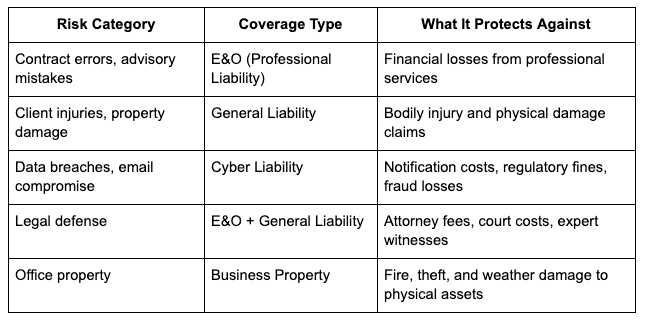
Client disputes and contract errors. When a buyer alleges the purchase contract didn’t accurately reflect agreed terms, or that conditions were drafted incorrectly, E&O coverage pays for legal defense and any resulting settlement. These claims are the most common in yacht brokerage because the transactional nature of the work creates multiple points where documentation and communication can go wrong.
Misrepresentation or advisory mistakes. Claims related to survey interpretation, market valuation, vessel condition representation, or advice about a vessel’s suitability for a buyer’s intended use. A buyer who purchases a vessel based on your representation that it’s suitable for offshore cruising, only to discover structural limitations, has grounds for an E&O claim regardless of whether the mistake was intentional.
Third-party bodily injury or property damage. General liability covers incidents at your office, during sea trials, at boat shows, during client events, or during vessel viewings.
Data breaches and cyber incidents. Breach notification costs, credit monitoring for affected individuals, regulatory penalties, legal defense, and first-party losses from business interruption or system restoration. A single compromised email account containing client financial information can trigger notification requirements in multiple states.
Legal defense costs. Both E&O and general liability include defense coverage, which is often the most expensive component of a claim, even when the underlying allegation is ultimately dismissed. A lawsuit that costs nothing in settlement can still cost $50,000 or more in legal fees to resolve.
How Much Does Yacht Broker Insurance Cost
Yacht broker insurance costs vary widely because premiums are tied to the size of the brokerage, the value of the vessels involved, and the nature of the firm’s day-to-day risk. A small independent broker handling lower-value transactions will typically pay far less than a larger firm placing high-value yachts, which is why pricing only becomes meaningful when viewed in the context of actual exposure.
Typical Cost Ranges
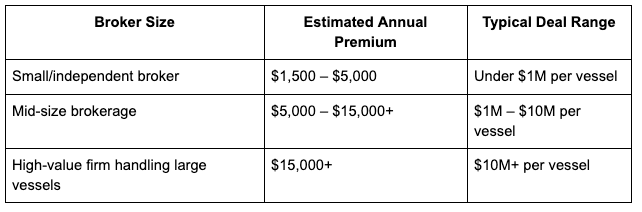
These ranges reflect combined E&O and general liability premiums. Cyber coverage typically adds $500 to $3,000, depending on revenue and data handling practices. Business property, if included, adds cost based on property value and location.
The wide range reflects the fact that a solo broker handling $500,000 sailboats has a fundamentally different risk profile than a multi-agent firm brokering $20 million superyachts. Premiums should reflect your actual exposure, not a generic industry average.
What Factors Affect Yacht Broker Insurance Cost
Yacht broker insurance pricing is shaped by the size of the transactions you handle, the structure of your business, and the level of professional exposure built into your day-to-day work. Because brokerage risk is tied to both financial stakes and operational complexity, insurers look closely at the factors that increase the likelihood or severity of a claim before setting a premium.
Transaction Value
The size of yachts you broker directly affects your E&O exposure. A broker handling $500,000 boats faces a different risk than one routinely brokering $10 million vessels, because the potential claim size scales with the transaction.
Annual Revenue
Insurers use revenue as a proxy for business volume and overall exposure. Higher revenue means more transactions, more client interactions, and more opportunities for claims.
Claims History
A clean record keeps premiums low. Prior E&O claims, general liability incidents, or cyber events increase pricing based on severity, recency, and frequency.
Number of Brokers or Agents
More people in your organization mean more potential sources of error or liability. Each additional broker increases the firm’s aggregate risk.
Geographic Exposure
International transactions, dealings in multiple jurisdictions, and cross-border sales introduce legal complexity that insurers price into the policy. A brokerage that handles transactions in the Caribbean, Mediterranean, and U.S. simultaneously faces more jurisdictional risk than one operating only in domestic waters.
Coverage Limits and Deductibles.
Higher limits cost more; higher deductibles reduce premiums. The optimal balance depends on your firm’s risk tolerance and financial capacity to absorb smaller losses out of pocket.
General Liability vs Professional Liability (E&O)
General liability and professional liability serve different functions within a yacht broker’s insurance program, and confusing the two can leave a major coverage gap. One protects against bodily injury and property damage tied to business operations, while the other addresses financial harm arising from professional services, which is why most brokerage firms need both rather than treating them as interchangeable.
These two coverages protect against fundamentally different risks, and both are essential. Understanding the distinction prevents a dangerous gap that catches many brokers off guard.
General liability responds to claims involving physical injury or property damage. If a client trips over a dock line during a vessel showing or a sea trial, resulting in damage to a marina dock, general liability covers the claim.
E&O responds to claims involving financial loss from professional services. If a client alleges your advice, representation, or contract work caused a financial loss, E&O applies. This is where the vast majority of yacht broker claims originate, because the nature of brokerage is advisory and transactional rather than physical.
General liability does not cover claims of professional negligence or financial loss. E&O does not cover bodily injury or property damage. A yacht broker with only general liability has no protection against the single largest category of risk in the brokerage business, which is like a doctor carrying property insurance on the office building but no malpractice coverage for the practice itself.
What Coverage Limits Should Yacht Brokers Consider
E&O limits should match the financial scale of your brokerage activity. Many brokers carry $1 million per occurrence / $2 million aggregate as a starting point, with higher limits for firms handling larger vessels. If your average transaction is $5 million, a $1 million E&O limit may be insufficient for a single serious claim.
General liability at $1 million per occurrence / $2 million aggregate is typical and sufficient for most brokerages, though firms that host frequent client events or operate showroom facilities may want higher limits.
Verify whether defense costs are included within the policy limit (eroding coverage) or provided in addition to the limit (not eroding). This distinction significantly affects available coverage for actual settlements, because a policy that includes defense within the limit can be substantially consumed by legal fees before any settlement is paid.
Key Exclusions to Watch For
Contractual Liability Gaps
Some policies exclude liability assumed under contract, which is problematic for brokers who routinely enter listing agreements, buyer representation contracts, and co-brokerage arrangements. If your business model depends on contractual relationships, this exclusion can undermine the entire purpose of the coverage.
Fraud or Intentional Acts
All policies exclude intentional fraud, but the scope of this exclusion matters. A broad exclusion could deny coverage for claims that merely allege fraud, even if the broker acted in good faith. Look for policies that cover defense costs for fraud allegations until fraud is proven.
International Transactions
Policies may exclude or limit coverage for transactions involving non-U.S. vessels, foreign buyers, or international closings. If your business includes cross-border deals, verify that coverage extends to those activities explicitly.
Cyber Exclusions
Some general liability and E&O policies now include cyber exclusions, meaning they won’t cover claims related to data breaches or electronic communication errors. If your E&O policy excludes cyber-related claims, standalone cyber coverage becomes essential rather than optional.
How to Choose the Right Yacht Broker Insurance Policy
Prioritize marine industry expertise over generic commercial coverage. A general commercial policy may technically cover some yacht broker risks, but it won’t be designed for them, and the exclusions will reflect a general underwriter’s view of risk rather than a marine specialist’s understanding of how brokerage claims actually develop.
Compare coverage terms and exclusions, not just premiums. The cheapest policy often has the narrowest coverage and the most exclusions, which means it provides the least protection precisely when you need it most. A $2,000 policy that excludes international transactions and caps defense costs within the limit may actually leave you more exposed than a $4,000 policy with broader terms.
Review exclusions carefully to ensure they don’t eliminate protection for risks you actually face. If you handle international transactions, verify international coverage. If you handle high-value deals, verify that limits are adequate. Explore our insurance solutions to see how Harbour evaluates and compares marine professional liability options.
Are There Specialized Yacht Broker Insurance Providers
Yes. The marine insurance market includes carriers and Lloyd’s syndicates that specifically underwrite yacht broker professional liability. These providers understand brokerage transaction structures, common claim patterns, and the specific exposures that generalist commercial insurers don’t account for.
The difference shows up in policy language: marine-specialist E&O policies are written with yacht brokerage scenarios in mind, while generic commercial E&O policies often contain exclusions or limitations that inadvertently eliminate coverage for the most common brokerage claims.
Harbour Insurance Agency helps yacht brokers access these specialized markets by comparing options from multiple carriers and selecting coverage that matches the specific risk profile of the brokerage. Visit our Service Center to start a coverage review.
How to Reduce Yacht Broker Insurance Costs
Implement risk management processes: Documented procedures for vessel inspections, contract review, client communication, and transaction management demonstrate professionalism that insurers reward with better pricing. A broker who can show a standardized process for every transaction presents lower risk than one who handles each deal ad hoc.
Use standardized contracts: Industry-standard listing agreements and purchase contracts reduce the risk of drafting errors that generate E&O claims. Customized contracts should be reviewed by maritime legal counsel before use.
Maintain strong documentation: Thorough records of all client communications, vessel inspections, survey results, and transaction details provide defense evidence if a claim arises. Insurers view strong documentation as a direct indicator of lower risk, and it also makes claims easier to defend when they do occur.
Bundle policies where possible: Combining E&O, general liability, and cyber coverage through a single carrier or program often produces better pricing than purchasing each separately, while also ensuring consistent terms across coverage types.
How Startups Can Get Affordable Yacht Broker Insurance
New brokerages face a common challenge: insurers want operating history and claims experience that startups don’t have. Despite this, affordable coverage is achievable with the right approach.
Start with essential coverage (E&O and general liability) from day one, because operating without these creates unacceptable exposure from your very first transaction. Scale limits as the business grows and average deal sizes increase. Work with an agency that has access to multiple marine insurers and can identify carriers willing to write new businesses and present the startup’s risk profile favorably.
The cost of starting with proper coverage is modest compared to the cost of a single uninsured E&O claim, which can easily exceed the first several years of premium combined. Many startups find that E&O coverage at $1 million limits costs less than $2,500 annually when placed through a broker who knows which carriers are receptive to new marine businesses.
As the brokerage establishes a track record and builds a claims-free history, renewal pricing typically improves and access to better carriers expands. The first year is the most expensive relative to revenue, but the exposure is also highest during those early transactions when processes are still being refined, and client relationships are new.
How Often Should You Review Your Insurance Program
Yacht broker insurance should be reviewed regularly because the exposure rarely stays static for long. Even if the business looks similar year to year, changes in premium levels, carrier terms, deal volume, market reach, or the types of vessels you handle can all affect whether the current program still fits the firm properly.
Annually, at a minimum: Premium rates, coverage terms, and carrier appetites change yearly. An annual review ensures your coverage still matches your current risk profile.
After major deals or business growth: A significant increase in transaction volume, average deal size, or number of brokers warrants a mid-year review. Your limits may no longer be adequate for the increased exposure.
When entering new markets: Expanding into international brokerage, new vessel categories, or charter management changes your risk profile and may require policy adjustments or endorsements.
Visit our Service Center for an annual coverage review, or call (239) 354-4053 to schedule one.
Protecting Your Brokerage the Right Way with Harbour Insurance
Yacht broker insurance isn’t overhead to minimize. It’s the financial foundation that allows you to operate confidently in a high-value, high-stakes industry, take on larger transactions without personal financial risk, and focus on growing the business rather than worrying about what happens when a client dispute escalates.
Harbour Insurance has helped marine professionals structure insurance programs across multiple specialized carriers. Learn about our agency and our approach to marine brokerage coverage.
Ready to compare options? Contact our team or call us at (239) 354-4053.
Frequently Asked Questions
What insurance does a yacht broker need?
At a minimum, yacht brokers need professional liability (E&O), general liability, and cyber liability. Business property insurance may also apply, depending on your office setup.
Is E&O insurance required?
Not universally mandated by law, but effectively required for professional practice. Most industry associations, co-brokerage partners, and clients expect it.
How much does yacht broker insurance cost?
Annual premiums range from $1,500 to $5,000 for small independents, $5,000 to $15,000+ for mid-size firms, and $15,000+ for high-volume operations.
What does yacht broker insurance cover?
Professional mistakes, contract errors, misrepresentation, third-party injury and property damage, data breaches, and legal defense costs.
Are there specialized yacht broker insurers?
Yes. Marine-focused carriers and Lloyd’s providers offer policies specifically designed for yacht brokerage risks, with better terms and fewer exclusions than generic commercial products.
Harbour Insurance Agency is an independent insurance agency helping yacht brokers access specialized marine insurance markets. Our agents compare E&O, liability, and cyber coverage from multiple carriers to build programs that match the specific risks of marine brokerage operations.