

A wine collection is no ordinary personal property. A case of first-growth Bordeaux, a vertical of aged Burgundy, or a cellar built over decades carries value that most homeowners policies were not designed to address.
Fine wine behaves more like a financial asset than a household possession. It can appreciate 5 to 10 percent annually, move independently of stock markets, even increase in replacement value every year the collection is held.
Once your collection grows beyond a few special bottles, it’s time to look closely at your insurance. This is especially true if you have invested in a home cellar, professional storage, or high-value auction purchases. In these scenarios, standard home insurance often falls short, making specialized wine collection insurance a necessity.
What Is Wine Collection Insurance?
Wine collection insurance is coverage designed to protect valuable wine bottles, private wine collections, or wine and spirits collections that may exceed the limits of an ordinary homeowners policy. Depending on the size, value, and complexity of a collection, protection may come through:
-
A valuable articles policy
-
A scheduled personal property endorsement added to an existing homeowners policy
-
A blanket collection limit covering the collection as a whole
-
A stand-alone collectibles policy
-
A private client insurance program designed for high-net-worth households with multiple valuable assets
What separates wine from ordinary household contents is that its value depends on vintage, provenance, storage conditions, rarity, and market demand.
None of those factors are ones a standard personal property claim process is built to evaluate accurately. A bottle worth $200 when purchased may carry a very different replacement value years later, or may lose value entirely if storage conditions fail.
That complexity is why insurance for high-value collections typically requires a different approach than insuring furniture or electronics. For collectors comparing specialist providers, a review of the best collectibles insurance companies can help identify the right fit before placing coverage.
Does Homeowners Insurance Cover a Wine Collection?
Homeowners insurance may provide some personal property protection for wine, but for a serious collection, that protection is often incomplete. A few specific issues tend to arise.
-
Coverage limits. Standard homeowners policies cap personal property coverage at a total limit, and some impose sublimits specifically for collectibles or valuable possessions. A collection worth $50,000 or $100,000 can exceed those sublimits without the collector ever realizing it.
-
Covered perils. Most homeowners policies cover named perils, including fire, theft, and certain water damage, but may not automatically cover temperature change, spoilage, breakage, equipment failure, or power outage-related losses. Wine is particularly sensitive to heat exposure, and a cooling system failure can affect an entire cellar.
-
Flood exclusions. Flood damage is generally excluded from standard homeowners policies. For Florida homeowners with ground-level or below-grade wine storage, that exclusion matters.
-
Valuation disputes. Even when coverage exists, the insurer’s valuation of a damaged or stolen bottle may not match the replacement cost, particularly for rare vintages whose market value has shifted.
-
Documentation. Without records (receipts, inventory logs, appraisals, photos), proving the value of individual bottles during a claim becomes significantly harder.
The more valuable the collection, the more these gaps matter. If you carry high-value home insurance in Florida or a high-net-worth homeowners policy, your situation may differ from standard coverage, but it is still worth reviewing the specifics with an advisor.
If your wine collection has grown beyond a few special bottles, Harbour Insurance can help you review whether your current homeowners policy gives your collection the protection it actually needs.
How Do I Insure My Wine Collection?
To insure a wine collection, create a detailed inventory, estimate the collection’s current value, review your homeowners policy, ask about scheduled or blanket collection coverage, and confirm how the policy handles storage, temperature change, breakage, transit, and off-site bottles. Here is how each step works in practice.
Create a Bottle-by-Bottle Inventory
A complete inventory is the foundation of any wine collection insurance plan. For each bottle or case, record:
-
Producer and label
-
Vintage
-
Region and appellation
-
Bottle size
-
Number of bottles
-
Purchase date and price
-
Current estimated value
-
Storage location
-
Photos of labels and storage conditions
-
Receipts, auction invoices, or appraisal records
-
Notes on provenance or condition
-
Whether cases are sealed or opened, and whether original wooden cases are present
The provenance record deserves particular attention. Where a bottle was sourced (from a reputable wine merchant, directly from a château, or through a professional storage facility) is one of the first questions a buyer or insurer will ask.
Bottles purchased from established, documented sources carry stronger provenance and are easier to value and verify. Some collectors are now using blockchain-based tracking tools that record ownership transfers, storage conditions, and chain of custody in a way that cannot be altered retroactively.
That kind of documentation is not yet standard practice, but it’s becoming more relevant as collections grow in value.
An original sealed case holds meaningfully more value than an opened one. If cases in the collection are partially consumed, that affects the insured value and should be reflected in the inventory.
This inventory helps set accurate coverage limits before a loss, and it supports a claim if bottles are stolen, damaged, or destroyed. An inventory that exists only in memory is not useful when a claim is filed.
Estimate the Current Value of the Collection
Purchase price is rarely the right number for insurance purposes. Rare vintages may appreciate significantly. Other bottles may fluctuate based on market demand, condition, storage history, or critical reassessment. The insured value needs to reflect what it would actually cost to replace each bottle today for coverage to be meaningful.
Serious wine collectors generally expect established, investment-grade bottles to appreciate between 5% and 10% annually. This target focus includes top Bordeaux classifications, premier cru Burgundy, and prestigious Champagnes. Historically, these asset classes tend to double in value over a standard 10-year holding period.
That rate of appreciation has direct insurance implications: a collection accurately valued at $80,000 two or three years ago may already be underinsured at that figure. After a strong vintage release, an auction spike, or shift in critic scores, the gap between insured value and replacement cost can widen quickly.
Ways to track current value include retail replacement pricing, recent auction results, professional appraisals, and collection management software. For larger or higher-value collections, an annual review with an appraiser can help keep limits accurate and identify bottles that may warrant scheduled coverage.
Review the Existing Homeowners Policy
Before assuming coverage is adequate, review the actual policy language with an advisor. Specific questions worth asking:
-
What is the personal property limit?
-
Are there sublimits for collectibles or valuable possessions?
-
Which perils are covered?
-
Are flood, water intrusion, and equipment breakdown included or excluded?
-
Is temperature-change damage covered?
-
Are off-premises bottles covered?
-
Are bottles in transit covered?
-
How are newly acquired bottles handled?
-
What documentation would be required during a claim?
Ask About Scheduled or Blanket Wine Collection Coverage
-
Scheduled coverage lists individual high-value bottles, cases, or lots separately, each with its own insured value. This approach works well for rare bottles or specific lots where the value is known and distinct. It typically offers the strongest protection for individual high-value items.
-
Blanket coverage applies a single limit to the collection as a whole. This can be more practical for larger collections with many bottles, where tracking and scheduling every item individually would be complex. The tradeoff is that individual bottle values are not specifically documented within the policy.
-
Private client or stand-alone collection coverage may be the right fit for collections with significant value, complex storage arrangements, or households that also hold other valuable assets, including art, jewelry, classic cars, or multiple properties.
Confirm Coverage for Storage, Transit, and Off-Site Bottles
Wine lives in multiple places. Coverage should account for all of them:
-
Bottles in the home and home wine cellar
-
Bottles in wine refrigerators or cooling units
-
Bottles in a professional storage facility
-
Bottles in transit, being shipped after an auction purchase or retailer order
-
Bottles temporarily moved for events or relocation
-
Newly acquired bottles not yet formally added to the policy
Transit timing is worth asking about specifically. Bottles shipped in summer heat, particularly in Florida where ambient temperatures can damage wine during unrefrigerated transport, may arrive in a condition that affects their value and potentially their insurability.
Some fine wine buyers treat summer transit as a red flag; collectors should confirm whether their policy addresses heat exposure during shipping.
Professional off-site storage raises a separate documentation point. A home cellar may be expertly maintained, but proving storage conditions over years requires deliberate records. Professional wine storage facilities, particularly those operating to certified standards, provide temperature and humidity records as a standard part of their service.
That documentation can matter in a claim where the insurer questions whether bottles were kept in conditions consistent with the coverage terms.
What Can Wine Collection Insurance Cover?
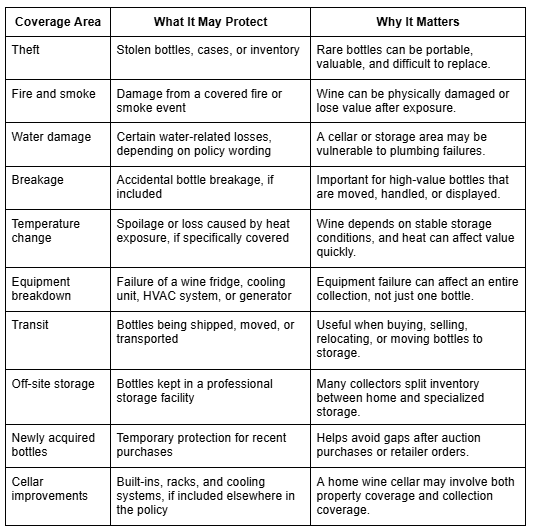
Coverage for a Home Wine Cellar
Insuring a home wine cellar requires two distinct layers of protection: property coverage for the structural cellar and climate systems (cooling units, backup generators), and specialized collection coverage (endorsements or stand-alone policies) for the actual bottles.
To maintain the collection’s insurable value, wine must be stored at 12°C to 14°C (7°C to 9°C for Champagne) and laid horizontally to keep the corks wet. Failure to do so can cause oxidation or heat damage (“cooked” bottles), risks that are typically excluded from standard homeowners policies unless specific equipment breakdown or spoilage riders are added.
The Two Pillars of Wine Cellar Insurance
A complete insurance strategy must address both the physical asset and the environment housing it. These components are rarely covered adequately under a single, standard policy.
-
The Physical Collection (The Bottles): Requires specialized fine art or valuable possessions coverage. Standard homeowners policies have strict sub-limits on high-value personal property that will leave a growing collection severely underinsured.
-
The Cellar Infrastructure (The Property): Covered under your home policy’s dwelling or “other structures” clause. This protects the custom racks, cabinetry, climate-control units, backup generators, and leak detection systems.
Expert Note: Gaps often exist between these two layers. A direct conversation with a specialized insurance advisor is required to ensure that a failure in the property layer (like a cooling unit breakdown) doesn’t void the coverage on your collection layer.
Critical Storage Requirements for Value Preservation
Understanding the science of wine storage is vital for insurance purposes. A bottle can look completely pristine on the outside but be deemed financially worthless due to invisible structural damage.
Temperature Control
-
Red and White Wines: Long-term storage requires a stable 12°C to 14°C.
-
Champagne and Sparkling: Best preserved at 7°C to 9°C.
-
The Refrigerator Trap: Standard household fridges run at 4°C to 5°C. This is too cold for long-term storage; the low humidity will dry out corks over time and degrade the wine.
Horizontal Orientation
Wines must be stored flat, never upright. Horizontal storage keeps the liquid in constant contact with the cork. If stored vertically, the cork dries out, shrinks, and allows oxygen into the bottle. This oxidizes the wine, destroying its market value. Experienced buyers can spot vertical storage damage immediately by looking for telltale wine stains seeping through the capsule.
Heat and Sun Exposure
Fine wine is highly sensitive to thermal shock. Just three hours of direct sun exposure during a hot summer can “cook” a bottle. This irreversible chemical change ruins the flavor profile and entirely erases its collectible value.
The Insurance Reality of System Failures
If a cellar’s cooling system fails during a heatwave, an entire collection can be ruined simultaneously. From an insurance perspective, whether this loss is covered depends entirely on your policy’s specific exclusions regarding equipment breakdown, temperature change, and spoilage. Standard policies routinely exclude these perils, making specialized riders essential.
A home wine cellar can involve bottles, cooling systems, custom storage, and Florida property risks. Harbour Insurance can help you evaluate how those exposures fit into your broader insurance plan.
Wine Collection Risks Florida Homeowners Should Consider
Florida presents a specific set of risks for wine collectors that collectors in other states may not face to the same degree.
Hurricane-related power outages are among the most common concerns.
Extended outages following a major storm can render cooling systems useless for days or weeks. A wine fridge or cellar cooling unit that loses power during a Florida summer can reach temperatures that damage or destroy an entire collection. The correct storage temperature for red wine is 12 to 14 degrees Celsius; cellar temperatures in an unventilated Florida home during a summer power outage can climb well above that within hours.
Flood exposure is real for many Florida properties, particularly those near the coast, in low-lying areas, or with ground-level storage.
Standard homeowners policies do not cover flood damage, and wine stored in a cellar or ground-floor room may be directly in the path of water intrusion after a storm surge or heavy rainfall.
Wind-driven rain and water intrusion can affect storage conditions even when a property does not flood.
Roof or window damage that allows moisture into a storage area can affect humidity levels and introduce mold or mildew that damages labels, corks, and ultimately the wine.
Equipment breakdown from power surges, voltage fluctuations, or mechanical failure is another exposure.
Generator failure during an outage, compressor failure in a cooling unit, or HVAC system breakdown can each affect an entire collection.
Summer transit is a risk that Florida collectors who ship wine from auctions or out-of-state retailers should consider specifically.
Bottles transported in non-refrigerated vehicles during Florida’s warmest months face heat exposure that can cook a bottle before it arrives. Collectors should confirm whether transit coverage accounts for heat-related damage and whether any shipping conditions apply.
Florida collectors with secondary homes or seasonal residences should also consider whether coverage travels with them and whether off-site storage during storm season is appropriately addressed.
Proper risk management for high-net-worth individuals means reviewing whether homeowners, flood, equipment breakdown, and valuable articles coverage work together rather than leaving gaps between them.
For collectors weighing broader property decisions, it’s also worth reviewing homeowners insurance in Florida without hurricane coverage to understand what that choice means for a full protection plan.
What May Not Be Covered Automatically?
Exclusions and limitations vary by policy, but collectors should specifically ask whether the following are covered, excluded, or available as an add-on:
Standard Policy Perils & Environmental Risks
-
Flood damage
-
Power outage-related temperature change
-
Utility interruption
-
Mechanical breakdown
-
Mold
-
Infestation
-
Gradual deterioration
-
Wear and tear
Logistical & Tracking Exclusions
-
Unexplained disappearance
-
Accidental breakage
-
Off-site bottles
-
Bottles in transit
-
Newly acquired bottles not yet reported to the insurer
-
Bottles without documented proof of value
-
Poor storage conditions
None of these are obscure edge cases. For a wine collection, several of them are predictable risks that deserve a direct answer from the policy, not a guess.
How Much Wine Collection Insurance Do You Need?
To determine exactly how much coverage you need, you have to look at valuation models and policy structures. Here is the specific, granular breakdown of how it actually works.
Step 1: Choose Your Valuation Model
You cannot just pick a random dollar amount. You must insure based on one of two distinct valuation methods written into the policy:
-
Market Value: The insurer pays what it would cost to buy the bottle on the open market on the day it was destroyed. This is risky for rare wines because a sudden market spike could leave you underinsured.
-
Agreed Value (Recommended): You and the insurer agree on the value of the bottles before the policy is signed, usually based on an appraisal or recent auction data. If a bottle breaks, they pay that exact amount, no questions asked.
Step 2: Choose Your Policy Structure
Your coverage limit is determined by how you group your bottles. Serious collectors use a hybrid of these two structures:
A. Scheduled Coverage (Itemized)
You list every high-value bottle individually with its specific vintage, description, and appraised value (e.g., 1945 Château Mouton Rothschild – $15,000).
-
When to use it: For investment-grade bottles worth more than $1,000 to $2,000 each.
-
The benefit: There is no deductible, and you get 100% of the agreed value if lost.
B. Blanket Coverage (Bulk)
You set a total dollar limit for the remainder of your collection without listing individual bottles (e.g., $50,000 total blanket coverage for 200 daily drinkers).
-
When to use it: For bottles valued under $1,000 that you frequently open, replace, or rotate.
-
The restriction: It includes a per-bottle payout cap (usually $1,000 or $2,000 maximum per claim).
Step 3: Calculate the “Hidden” Risk Clauses
To find your final coverage limit, you must add specific riders to your base collection value to cover active logistics:
-
Transit/Auction Limit: If you buy at auction, you need a limit that covers the bottles from the moment the hammer falls, through transport, until they hit your cellar. A standard baseline is $50,000 of transit coverage.
-
Newly Acquired Bottles Clause: Look for a policy that automatically covers new purchases for 25% to 30% of your total policy limit for the first 30 to 90 days. This gives you a buffer to report new purchases to your insurer without being temporarily uninsured.
-
Inflation Guard: Ensure the policy has a 150% valuation clause. If a rare vintage spikes in value right before a total loss, this clause allows the insurer to pay up to 150% of the scheduled amount to cover the true replacement cost.
Wine Collection Insurance Checklist
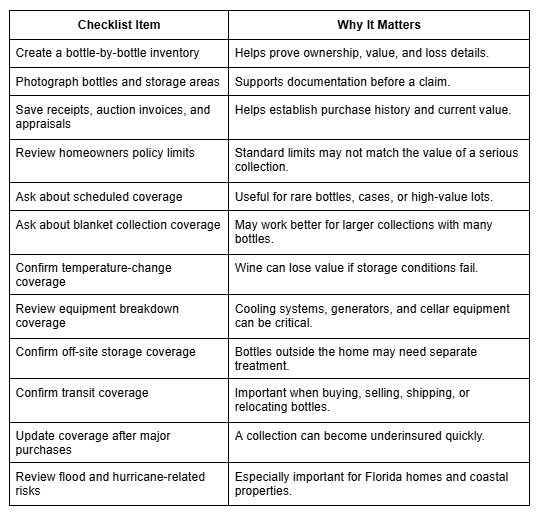
Questions to Ask Before Buying Wine Collection Insurance
Before settling on a policy, bring these questions to your advisor:
-
Does my homeowners policy cover wine as ordinary personal property?
-
Are there sublimits for collectibles or valuable possessions?
-
Can I schedule individual bottles, cases, or lots?
-
Can I insure the collection under a blanket limit?
-
Is accidental breakage covered?
-
Is temperature change covered?
-
What happens if my wine fridge or cellar cooling system fails?
-
Is equipment breakdown included or available as an add-on?
-
Are bottles in transit covered?
-
Are bottles in professional storage covered?
-
Do I need an appraisal?
-
How often should I update the collection value?
-
Does the policy cover newly acquired bottles?
-
Is flood damage excluded?
-
Are hurricane-related losses treated differently?
-
What documentation would I need to support a claim?
Why Work With a Private Client Insurance Advisor?
Wine collection insurance rarely exists in isolation. For households with a high-value home, art, jewelry, classic cars, a yacht, or multiple properties, a collection policy is one piece of a broader protection plan. The gaps between policies matter as much as the coverage each one provides.
A private client advisor reviews how your wine collection interacts with your homeowners policy. By identifying where you need flood, equipment breakdown, or valuable articles coverage, they eliminate hidden gaps. This prevents a dangerous scenario where individual policies look adequate on paper but collectively leave your wealth completely exposed.
This kind of coordinated review is particularly relevant for Florida collectors managing hurricane exposure, flood risk, and the equipment vulnerabilities that come with maintaining climate-controlled storage in a high-risk environment.
Households managing types of insurance for high-net-worth individuals across multiple asset categories benefit most from an advisor who understands how those pieces interact.
For collectors whose wine sits alongside other significant assets, the same valuation and documentation questions arise across categories.
-
The art insurance cost conversation raises the same issues around appraised value, scheduled coverage, and provenance that wine collectors face.
-
Classic car insurance cost involves similar questions around agreed value and storage conditions.
-
Collectors who also own vessels will find the same coverage structure considerations in yacht insurance quotes.
-
For households where all of these assets come together, ultra-high-net-worth insurance programs are designed to coordinate that coverage in a single plan.
The NAIC’s home inventory guidance is a useful starting point for documentation. The Insurance Information Institute’s overview of special coverage for valuables explains how floaters and endorsements work in plain terms.
Have a wine cellar, rare bottles, or a growing private collection? Contact Harbour Insurance to review wine collection insurance options and identify gaps before a loss happens.
Frequently Asked Questions
How do I insure my wine collection?
To insure a wine collection, create a digital inventory logging each bottle’s producer, vintage, purchase price, and current market value. Then, have a specialized insurance advisor add a valuable articles endorsement (scheduled or blanket coverage) to your homeowners policy, or purchase a standalone collectibles policy.
Does homeowners insurance cover wine collections?
Standard homeowners insurance covers wine as basic personal property, but it is usually insufficient for serious collections. Standard policies have low financial sub-limits for collectibles and typically exclude coverage for accidental breakage, theft, and environmental damage like temperature spoilage.
Can I insure a home wine cellar?
Yes. Insuring a home wine cellar requires two layers of coverage: a valuable articles policy to protect the actual wine bottles, and your standard homeowners policy (dwelling or other-structures coverage) to protect the physical cellar structure, cooling systems, and custom racks.
Is wine covered if a power outage ruins it?
Wine ruined by a power outage is not automatically covered. Protection against climate-control failure requires specific policy riders for equipment breakdown, utility interruption, or spoilage, which explicitly cover temperature-change damage to perishable items.
Do I need an appraisal for wine collection insurance?
A formal appraisal is not always required for blanket policies, but it is highly recommended for rare or investment-grade bottles. For scheduled (itemized) coverage, insurers generally require an official appraisal or recent auction invoice to establish the agreed replacement value.
Is wine in storage covered by insurance?
Off-site storage is not automatically covered by standard home insurance. You must check your policy’s specific transit and off-site storage clauses, or add a dedicated endorsement to cover bottles kept in professional facilities or moving between locations.
What is the best way to document a wine collection?
The best way to document a collection is through a digital inventory app backed up to the cloud. For every bottle, record the producer, vintage, purchase price, and storage location, and attach digital copies of receipts, professional appraisals, and high-resolution photographs.




