
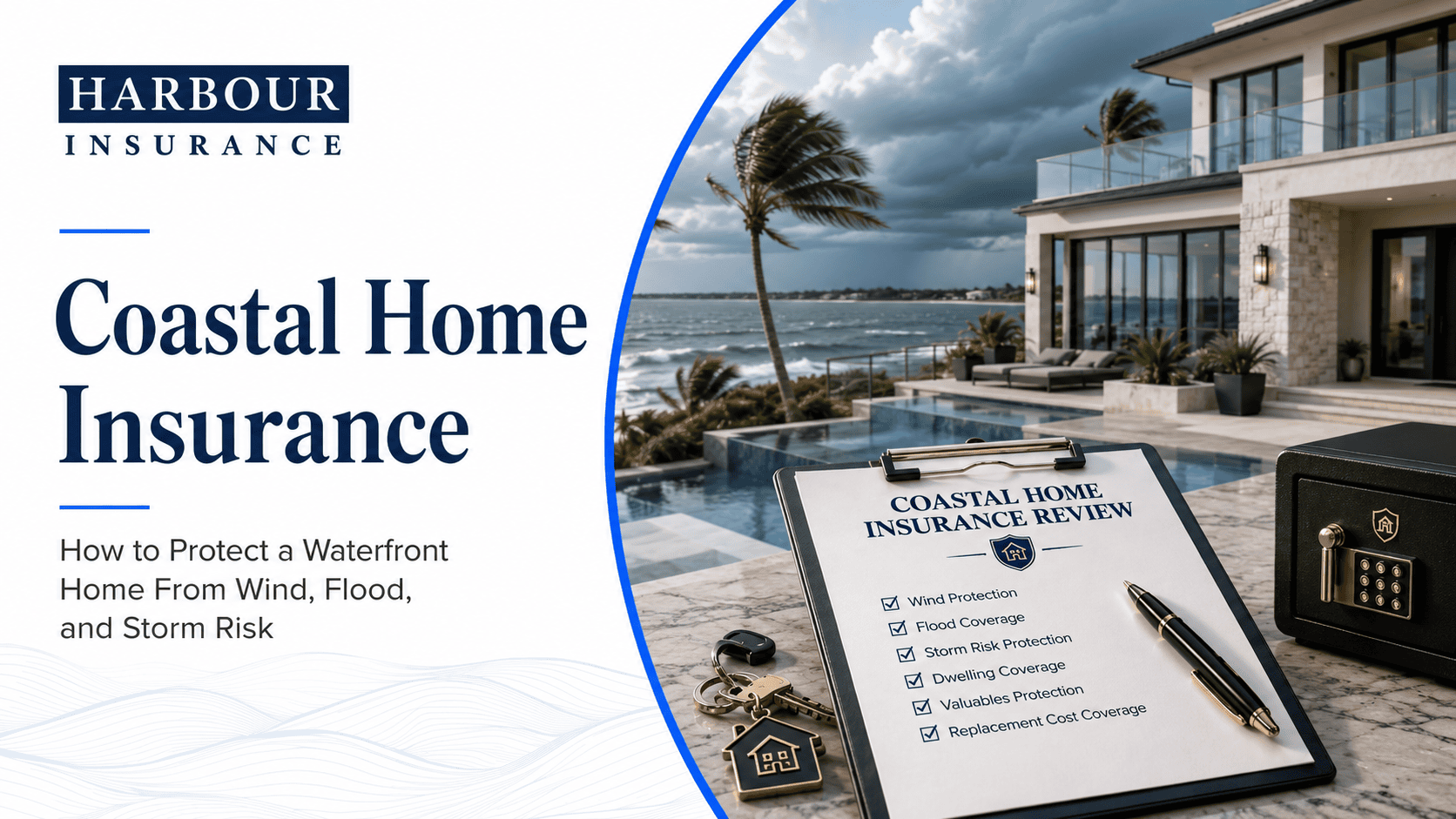
A house on the water carries a different risk profile than one three miles inland, even if they’re built from the same plans. Wind, storm surge, saltwater, elevation, and roof exposure all factor into how a waterfront property gets underwritten, and owners are often surprised to learn that “coastal home insurance” usually isn’t one policy at all. It’s several coverages working together, and understanding where each one starts and stops matters more here than almost anywhere else in property insurance.
This guide walks through how coastal home insurance works, why wind and flood are treated as separate questions, and what waterfront homeowners should review before buying or renewing coverage.
What Is Coastal Home Insurance?
Coastal home insurance is homeowners coverage designed for properties near the ocean, Gulf, bay, Intracoastal, canal, river, or other water exposure. These homes tend to face higher underwriting scrutiny because of hurricane, windstorm, flood, storm surge, saltwater, roof, elevation, and access risks that inland properties simply don’t carry.
A coastal home is often protected through several coverage components working in tandem: homeowners insurance, windstorm or hurricane coverage, flood insurance, excess flood insurance, other structures coverage, personal property coverage, valuable articles coverage, umbrella liability, equipment breakdown, sewer or drain backup, and ordinance or law coverage. High-value waterfront homes often need a private client approach built around all of this rather than a single off-the-shelf policy, which is worth pairing with a review of high-value home insurance in Florida.
How Do I Insure a Waterfront Home?
To insure a waterfront home, review the home’s replacement cost, location, flood zone, elevation, roof condition, wind mitigation features, hurricane exposure, flood coverage, other structures, valuable contents, and liability risk.
1. Confirm the Home’s Replacement Cost
Coastal homes should be insured based on the cost to rebuild, not market value, purchase price, or tax assessment, and this gap tends to be wider on the water than anywhere else. Custom construction, high-end finishes, and waterfront-specific building costs all push rebuild estimates higher, as do coastal building codes, elevated foundations, impact windows, and specialty roofing. Outdoor living areas, guest houses, pool houses, docks, and seawalls each need their own line in the estimate, and it’s worth remembering that contractor access can be limited for months after a major storm, which affects both timeline and ordinance or law costs.
2. Review Wind and Hurricane Coverage
Windstorm and hurricane coverage may be included, excluded, limited, or subject to a separate deductible depending on the policy and the property’s location. Hurricane, named storm, and windstorm deductibles often work differently from a standard deductible, so it’s worth confirming which applies and how it’s calculated. Roof age, shape, and materials matter to underwriters, along with opening protection: impact-rated windows and doors, shutters, and garage door reinforcement. A wind mitigation inspection can help document these features, though older homes and certain coastal ZIP codes may still face underwriting restrictions regardless, which is exactly the territory covered in homeowners insurance in Florida without hurricane coverage before anyone waives wind protection near the coast.
3. Review Flood and Storm Surge Exposure
Flood and storm surge are usually separate from homeowners insurance entirely, and this is the single most important distinction for a waterfront buyer to understand. FEMA flood zones, elevation certificates, and base flood elevation all factor into flood insurance rating, and coverage should reflect the real difference between storm surge, tidal flooding, and rain-related flooding, since a policy can treat these differently. Flood policy limits often need review alongside excess flood insurance for higher-value homes, and contents coverage, enclosures below elevated homes, and waterfront structures like docks and seawalls each deserve their own look rather than an assumption that the main flood policy handles everything. Flood insurance details are worth reviewing directly with an advisor rather than guessed at.
4. Review Other Structures and Waterfront Features
Waterfront properties often include expensive features that aren’t automatically or fully covered: docks, seawalls, boat lifts, piers, and bulkheads, plus detached garages, guest houses, pool houses, and cabanas. Outdoor kitchens, fences, gates, tennis or sport courts, landscaping, pools and spas, and decks and patios round out the list of things worth confirming individually rather than assuming blanket coverage.
5. Coordinate Liability and Valuable Property Coverage
Coastal homes often carry higher liability and personal property exposure than a typical residence. Guests, pool and dock injuries, and boat-adjacent exposure are common concerns, as is staff and vendor activity: housekeepers, property managers, and waterfront visitors all create some level of premises risk, particularly during entertaining. Art, jewelry, wine, firearms, musical instruments, and other collectibles kept at the property tend to exceed standard contents limits, which is where umbrella liability and scheduled coverage both come into play, alongside anything docked out back that might call for its own yacht insurance quotes review.
If you own or are buying a coastal home, Harbour Insurance can help review replacement cost, windstorm coverage, flood insurance, hurricane deductibles, and waterfront structures before a storm exposes a gap.
Coastal Home Insurance With Wind and Flood
Coastal homeowners shouldn’t assume wind and flood are handled the same way, because they rarely are. Wind coverage addresses wind-related damage to the home, roof, windows, doors, and other covered structures, subject to policy terms and deductibles. Flood coverage generally addresses rising water, storm surge, tidal flooding, and other flood events, but only if a separate flood policy or endorsement is in place.
A single hurricane can cause both wind damage and flood damage in the same event, which is exactly why the homeowner needs to know which policy responds to which part of the loss before a claim, not during one.
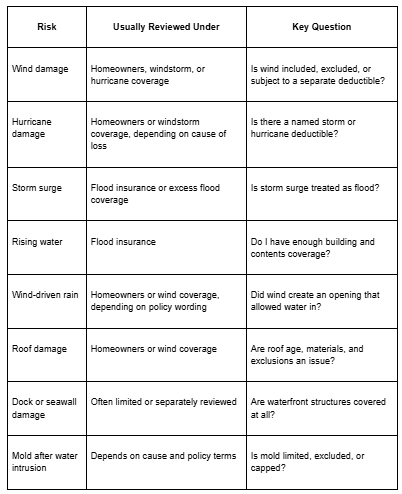
Wind and flood are not the same insurance question. Harbour Insurance can help coordinate coastal home insurance, flood coverage, excess flood, and private client protection for high-value waterfront properties.
What Does Coastal Home Insurance Cover?

What May Not Be Covered Automatically?
Exclusions vary by carrier, but coastal homeowners should ask about flood damage, storm surge, tidal flooding, earth movement, erosion, and seawall or dock failure specifically, since these are among the most commonly misunderstood exclusions on the water. Mold, gradual water intrusion, wear and tear, roof age exclusions, and cosmetic roof damage are frequent points of dispute, as is wind-driven rain and saltwater corrosion over time.
Landscaping, pools and screened enclosures, outdoor kitchens, fences, gates, and other detached structures often need separate confirmation, along with valuable items that haven’t been scheduled. Vacancy or seasonal occupancy, short-term rental activity, and renovation or construction work each change the risk picture and need to be disclosed. Ordinance or law limits, power outage-related losses, sewer backup, and service line damage round out the list, and high hurricane deductibles with specific named storm triggers deserve a close read before signing anything.
Why Coastal Home Insurance Can Be More Expensive
Coastal homes generally face higher risk and higher rebuild costs than inland properties, and that combination shows up directly in pricing.

Flood Zones, Elevation Certificates, and Excess Flood
A flood zone is a mapped area showing flood risk; coastal homes are often in higher-risk zones, though flood risk exists outside mapped high-risk zones too, which surprises plenty of inland-adjacent owners. An elevation certificate documents building characteristics and elevation details used for flood insurance rating and risk evaluation. Excess flood coverage adds protection above the primary flood policy limit, which matters for high-value coastal homes where the standard limit isn’t enough to rebuild or replace contents.
Building coverage and contents coverage are typically rated separately, and enclosures below elevated homes carry their own limitations worth understanding upfront. Storm surge, FEMA flood maps, and coastal AE and VE zone designations all factor into how a specific property gets rated, and it’s worth discussing both private flood options and NFIP coverage with an advisor rather than assuming one is automatically better. Lender requirements can also dictate minimum flood coverage regardless of what the owner would otherwise choose.
High-Value Coastal Home Insurance
High-value coastal homes often need a broader private client review because of what they typically include: waterfront construction, custom architecture, high-end interiors, guest houses, pool houses, outdoor kitchens, docks, boat lifts, and seawalls. Wine rooms, art collections, firearms, musical instruments, jewelry, and watches frequently sit inside these homes, and yachts, exotic cars, and private aircraft are often nearby. Domestic staff, property managers, and multiple residences add their own complexity, and ownership through a trust, LLC, or family office is closer to family office insurance territory than a standard homeowners review, which is exactly where risk management for high-net-worth individuals planning comes in.
Florida Coastal Home Insurance Considerations
Florida’s coastal owners deal with a specific combination of hurricane exposure, windstorm coverage, and named storm deductibles layered on top of flood and storm surge risk. Saltwater corrosion, roof age, and older construction all draw underwriting attention, which is part of why wind mitigation features, like impact windows and garage door protection, carry real weight in this market. Waterfront construction, storm shutters, seawalls and docks, and pool cages or outdoor structures each factor into both risk and premium.
Seasonal occupancy is its own consideration here: snowbird homes, properties owned by out-of-state residents, and homes left vacant during part of the year all carry different risk profiles than a year-round residence. High rebuild costs and shifting coverage availability in certain coastal ZIP codes make proactive renewal reviews genuinely worthwhile rather than a formality.
Coastal Homes, Second Homes, and Snowbird Properties
Many coastal homes double as second homes, seasonal residences, or snowbird properties, and that overlap changes how the policy should be reviewed. Owner-occupied year-round use is one thing; seasonal, snowbird, vacation, second home, short-term rental, and family-use patterns are each their own category, and vacant or unoccupied periods bring their own set of questions on top of the usual wind and flood review.
Property managers and caretakers, storm preparation while the owner is away, water leak detection, security monitoring, and valuable contents left in the home all need to be part of that conversation rather than an afterthought once the season starts.
Waterfront Structures: Docks, Seawalls, Boat Lifts, and Pools
These features need their own review because they’re frequently limited, excluded, or handled through a separate endorsement. Docks, piers, boat lifts, seawalls, bulkheads, and retaining walls sit in one category; pools, spas, pool cages, outdoor kitchens, and cabanas sit in another. Decks, patios, fences, gates, landscaping, and other shoreline structures round out the list.
None of this is automatically covered just because it’s attached to an insured home. Ask specifically whether each structure is covered, excluded, limited, or insurable only through a separate policy or endorsement.
Contents, Collections, and Valuable Property in Coastal Homes
Coastal homes often hold belongings well beyond furniture: art, jewelry, watches, wine, firearms, and musical instruments turn up in waterfront properties more often than standard contents limits account for. Antiques, designer furniture, electronics, collectibles, boating equipment, golf equipment, and family heirlooms add further exposure worth documenting.
For a broader collection, collectibles insurance and art insurance cost are worth reviewing directly. Jewelry and watches usually need their own conversation too, which is where jewelry insurance and luxury watch insurance come in.
Liability Risks for Coastal and Waterfront Homes
Waterfront homes tend to carry more liability exposure than standard residences, largely because of what happens on and around the water. Pool and dock injuries, guest and vendor injuries, and boat-adjacent exposure are common concerns, along with slips and falls during outdoor entertaining, where alcohol-related guest risk sometimes enters the picture too. Domestic staff, property managers, housekeepers, and contractors all create some level of premises exposure, and short-term rental guests or special events can raise it further.
This is exactly where umbrella liability tends to matter most, and it’s worth reviewing excess liability insurance directly rather than assuming the base policy limit is enough. If a boat sits at the dock, luxury yacht insurance cost is worth coordinating at the same time.
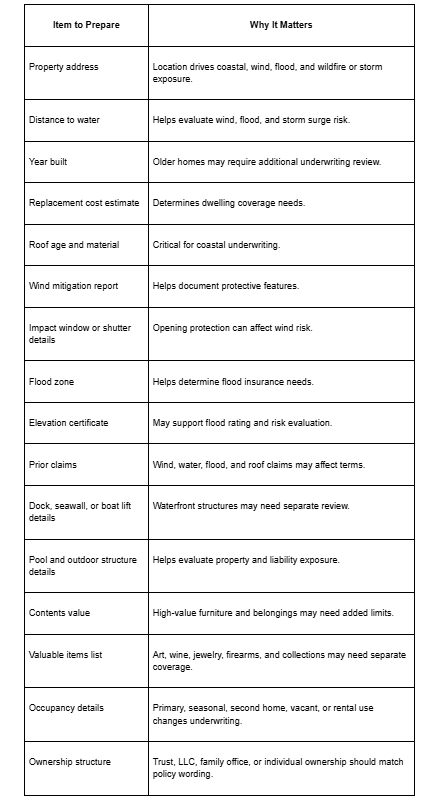
Coastal Home Risk Management Checklist

What to Prepare Before Getting a Coastal Home Insurance Quote
Questions to Ask Before Buying Coastal Home Insurance
-
Does this policy cover windstorm damage?
-
Is there a hurricane or named storm deductible?
-
Is the deductible a percentage or flat amount?
-
Does the policy exclude wind in my coastal area?
-
Does homeowners insurance cover flood or storm surge?
-
Do I need separate flood insurance?
-
Do I need excess flood coverage?
-
Is wind-driven rain covered?
-
How does the policy treat roof age?
-
Are impact windows, shutters, and roof upgrades reflected?
-
Are docks, seawalls, and boat lifts covered?
-
Are pools, pool cages, cabanas, and outdoor kitchens covered?
-
Is ordinance or law coverage included?
-
Are valuable contents fully covered?
-
Do I need scheduled coverage for art, wine, jewelry, firearms, or instruments?
-
Is the home insured for replacement cost?
-
Does seasonal or vacation use affect coverage?
-
Does short-term rental use change the policy?
-
Is umbrella liability coordinated with the coastal home policy?
-
What should be reviewed before hurricane season?
Putting the Full Coastal Picture Together
Coastal home insurance is rarely a one-policy decision for a high-value waterfront property. Homeowners insurance, windstorm coverage, flood and excess flood, umbrella liability, and valuable articles coverage often need to work as a set rather than in isolation, and the same goes for second home or seasonal coverage, domestic staff protection, and trust or LLC ownership structures. A private client advisor can pull these pieces together and flag gaps before storm season, a renewal, a major renovation, or a property purchase, rather than after a claim reveals them.
For owners whose waterfront lifestyle spans several asset categories, that’s the same coordination work covered in types of insurance for high-net-worth individuals.
Own a coastal, waterfront, bayfront, or canal-front home in Florida? Contact Harbour Insurance to review coastal home insurance options and identify wind, flood, storm surge, liability, and valuables coverage gaps.
Frequently Asked Questions
How do I insure a waterfront home?
To insure a waterfront home, review replacement cost, windstorm coverage, flood insurance, storm surge exposure, roof condition, elevation, other structures, valuable contents, and liability limits. Coastal homeowners should not assume one standard homeowners policy covers every waterfront risk.
Does coastal home insurance include wind and flood?
Not always. Wind may be included, excluded, or subject to a separate deductible depending on the policy. Flood and storm surge are usually reviewed separately through flood insurance or excess flood coverage.
What is the difference between wind damage and flood damage?
Wind damage is caused by wind, such as roof, window, or exterior damage from a storm. Flood damage usually involves rising water, storm surge, tidal flooding, or water entering from outside the home. The difference matters because different policies may respond.
Do coastal homes need flood insurance?
Many coastal homes should review flood insurance, even if it is not required by a lender. Standard homeowners insurance generally does not cover flood damage, and waterfront homes may face storm surge, tidal flooding, or heavy rain exposure.
What is a hurricane deductible?
A hurricane deductible is a separate deductible that may apply to hurricane or named storm losses. It is often calculated as a percentage of the insured dwelling value rather than a flat dollar amount.
Are docks and seawalls covered by coastal home insurance?
Docks, seawalls, boat lifts, piers, and bulkheads may be limited, excluded, or treated differently from the main dwelling. Coastal homeowners should ask specifically how each waterfront structure is covered.
Why is coastal home insurance expensive?
Coastal home insurance can cost more because coastal homes face wind, hurricane, flood, storm surge, roof, water intrusion, and high rebuilding-cost risks. Custom construction, waterfront features, and high-value contents can also affect cost.
Do high-value coastal homes need special insurance?
Yes, high-value coastal homes often need a private client review because they may include custom construction, expensive contents, waterfront structures, guest houses, pools, docks, art, wine, jewelry, yachts, and umbrella liability needs.




