

Family office insurance is not one policy. It is a coordinated risk management program designed to protect the family, the family office entity, its directors and officers, employees, trustees, digital systems, personal assets, and operational decisions. A family office may need private client insurance, D&O, E&O, fiduciary liability, cyber, crime, EPLI, kidnap and ransom, travel accident, personal umbrella or excess liability, household staff coverage, and specialty property coverage. Harbour Insurance Agency helps high-net-worth Florida families and family offices review coverage needs and compare options from reputable insurance carriers.
Key takeaways:
-
Family office insurance must protect both personal wealth and the family office entity separately.
-
A personal umbrella policy does not cover entity-level risks such as investment advice errors, fiduciary claims, employment disputes, or cyber incidents involving the office.
-
Core coverage areas may include D&O, E&O, fiduciary liability, EPLI, crime, cyber, kidnap and ransom, travel accident, and private client insurance.
-
Family offices should review personal, business, trust, property, employee, travel, cyber, and governance exposures together rather than as separate decisions.
-
Embedded family offices inside operating companies can have hidden coverage gaps that neither the personal nor the business policy addresses.
-
Risk management should include controls, staff training, vendor review, wire transfer protocols, data security, valuations, and regular policy reviews.
What Is Family Office Insurance?
Family office insurance is a coordinated set of insurance policies and risk management practices designed to protect a family office and the family it serves.
It may include coverage for:
-
The family’s personal assets and lifestyle exposures
-
The family office entity and its operations
-
Directors, officers, managers, and decision-makers
-
Employees, household staff, and trustees
-
Professional services provided by or through the family office
-
Cyber and privacy incidents affecting the entity or family members
-
Wire transfer fraud and financial crime
-
Travel and security risk for family members and staff
-
Homes, autos, yachts, aircraft, art, jewelry, and collections
-
Fiduciary and governance decisions
-
Employment-related claims
The personal umbrella policy that covers a family’s home and auto liability does not extend to the family office acting as an employer, manager, fiduciary, administrator, or professional service entity. That distinction is the starting point for any family office insurance conversation.
Why Family Offices Need a Different Insurance Strategy
A family office is not just a household. Depending on its structure, it may function simultaneously as a private company, wealth management operation, employer, trust administrator, property manager, concierge, and risk coordinator across multiple generations.
That creates unusual risk because the family office may:
-
Manage sensitive financial records for multiple family members
-
Coordinate investment accounts, advisors, and reporting
-
Employ staff with access to confidential data
-
Handle large wire transfers and vendor payments
-
Manage multiple homes and property vendors
-
Support trust administration and fiduciary decision-making
-
Book international travel and coordinate security
-
Hold personal data including passports, tax returns, and medical information
-
Make financial and administrative decisions with consequences for beneficiaries
-
Support business, real estate, philanthropic, or foundation entities
Families often assume their personal insurance or their operating company’s insurance is sufficient. In most cases it is not, and the gap between the two is where family office-specific risk lives.
What Insurance Does a Family Office Need?
A comprehensive family office insurance program may include the following, depending on structure and risk profile:
Private client personal coverage:
-
High-value homeowners insurance for all residences
-
Auto, collector car, yacht, aircraft, and specialty vehicle insurance
-
Valuable articles, art, jewelry, wine, and collectibles coverage
-
Domestic staff and household employee coverage
Entity-level coverage for the family office:
-
Directors and officers insurance
-
Errors and omissions or professional liability insurance
-
Fiduciary liability insurance
-
Employment practices liability insurance
-
Crime and fidelity coverage
-
Cyber liability insurance for the entity
-
Kidnap, ransom, and extortion coverage
-
Travel accident and travel risk coverage
-
Trustee liability coverage
-
Event liability where the family hosts large private or philanthropic events
Not sure where personal coverage ends and family office risk begins? Harbour Insurance Agency can help review your current policies and compare family office insurance options from trusted carriers.
Personal Insurance for the Family
Family offices should conduct a systematic review of personal insurance across all family members and assets, not just the primary household.
High-Value Homes
Florida residences, coastal properties, secondary homes, seasonal homes, and properties under renovation each carry distinct risk. Hurricane, windstorm, flood, water damage, and coastal exposure require specific attention. High-value homeowners insurance should reflect current replacement costs, not purchase price.
Auto and Collector Vehicles
Luxury vehicles, collector cars, family drivers, chauffeurs, teen drivers, and hired drivers each create separate liability exposure. Auto liability limits should be reviewed in the context of the umbrella or excess liability structure.
Yacht and Watercraft Insurance
Florida families with boats and yachts face watercraft liability that sits outside their homeowners policy and may not automatically connect to umbrella coverage. Review yacht insurance, crew liability, navigation territory, tenders, and water toys as distinct components.
Personal Umbrella and Excess Liability
Coverage above homeowners, auto, watercraft, and other underlying policies. For high-net-worth families, excess liability insurance through carriers offering higher limits may provide a better structure than a standard umbrella product.
Valuable Articles and Collections
Art, jewelry, watches, wine, antiques, collectibles, and rare assets should be scheduled and appraised. Valuable possessions insurance addresses the gap between homeowners sublimits and the actual value of a collection.
Personal Cyber and Identity Theft
Coverage for online fraud, identity restoration, cyber extortion, data restoration, cyberbullying, and reputation incidents. Personal cyber coverage protects individual family members; a separate entity-level cyber policy is needed for the family office itself.
Domestic Staff Coverage
Housekeepers, nannies, drivers, estate managers, chefs, caretakers, and personal assistants may require workers’ compensation, employment practices review, and background screening. Their access to personal information, financial records, children, and property creates risk that sits outside most personal policies.
Entity-Level Insurance for the Family Office
This is the coverage layer most families are missing, and it is where the largest uninsured risks tend to concentrate.
Directors and Officers Insurance
D&O insurance can help protect directors, officers, managers, and decision-makers from claims involving governance, management decisions, conflicts of interest, or alleged mismanagement. Family office executives, investment committee members, and family principals who serve in governance roles carry personal exposure that a homeowners or umbrella policy does not address.
Errors and Omissions Insurance
E&O, also called professional liability insurance, may respond to claims alleging mistakes in professional services or advice provided by or through the family office. Common scenarios include investment administration errors, failure to execute instructions, miscommunication with advisors, incorrect reporting, failure to maintain records, and administrative oversights that result in financial harm to a family member or beneficiary.
Fiduciary Liability Insurance
Fiduciary liability may be needed when family office executives, trustees, committee members, or employees make decisions involving trusts, benefit plans, investment oversight, or duties owed to beneficiaries. The exposure can be personal for anyone serving in a fiduciary capacity.
Trustee Liability
If a family office executive or family member serves as trustee, personal liability exposure may extend beyond standard D&O coverage. A trustee accused of mismanaging assets, failing to follow trust terms, or treating beneficiaries unequally faces claims that require specific coverage review.
Employment Practices Liability Insurance
EPLI may respond to claims involving wrongful termination, discrimination, harassment, retaliation, wage and hour disputes, and other employment-related allegations. This applies both to family office employees and, depending on the structure, to household staff coordinated through the office.
Crime and Fidelity Coverage
Crime insurance may help address employee theft, forgery, funds transfer fraud, social engineering fraud, wire transfer fraud, and vendor payment fraud. This coverage is critical because family offices regularly handle large transactions and place significant trust in employees, advisors, and vendors. A single successful social engineering attack on a staff member can result in a wire transfer loss that no personal policy covers.
Cyber Liability Insurance for the Entity
A family office entity needs business cyber liability coverage separate from personal cyber insurance for family members. Entity-level cyber coverage may include incident response, breach notification, forensics, business interruption, data restoration, cyber extortion, regulatory support, privacy liability, and social engineering or funds transfer fraud where included.
A family office cyber incident can simultaneously compromise tax records, trust documents, investment files, medical information, passports, property records, and wire instructions for multiple family members across multiple accounts.
Kidnap, Ransom, and Extortion Coverage
KR&E may be relevant for families with public visibility, international travel, executives, children studying or working abroad, or philanthropic work in higher-risk regions. Response speed and crisis coordination are as important as the financial coverage.
Travel Accident and Travel Risk Coverage
Travel coverage may be relevant for family principals, family members, executives, household employees, security staff, and family office employees traveling for personal or office-related purposes. Medical evacuation, crisis response, and international coverage requirements should be reviewed specifically.
Personal Risk vs. Family Office Risk: Where Personal Policies Stop
A family’s personal policies cover personal exposures. They generally do not cover the family office acting as an employer, manager, fiduciary, advisor, or administrative entity.
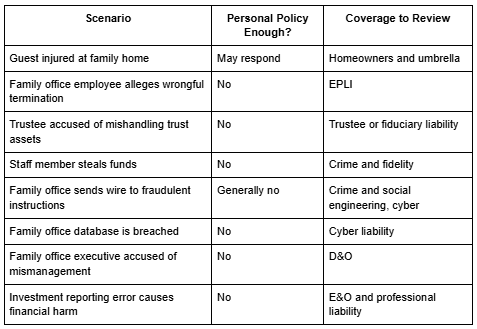
The gap between personal and entity coverage is not theoretical. It is where claims go uninsured.
Embedded Family Office Risks
Many families do not operate a standalone family office. Instead, the office functions inside a family business, holding company, foundation, trust structure, or informal administrative setup. This creates blind spots that can be more dangerous than a recognized coverage gap because neither party assumes responsibility for them.
Common embedded office coverage problems include:
-
The operating company’s policy excluding family office or wealth management services
-
D&O not responding to disputes between family members and the entity
-
Employment coverage not extending to household employees
-
Business cyber coverage not including personal family systems
-
Personal umbrella not covering entity-level claims
-
Trust and fiduciary roles being entirely uninsured
-
Operating company policies not covering personal wealth management activities
-
Insured-versus-insured exclusions blocking claims between family members and the entity
Families with embedded office structures should have their coverage mapped explicitly rather than assuming existing policies cover the overlap.
Cyber Risk Management for Family Offices
Cyber risk deserves its own treatment because family offices hold exactly the information that sophisticated threat actors seek.
Sensitive data commonly held by a family office includes tax returns, passport scans, trust documents, wire instructions, investment statements, medical information, property records, travel schedules, children’s information, household staff data, and vendor payment details. A successful breach can expose the entire family’s financial and personal infrastructure simultaneously.
Controls that should accompany any cyber insurance coverage:
-
Multi-factor authentication on all financial and email accounts
-
Role-based access limiting staff to information they actually need
-
Dual approval protocols for all wire transfers
-
Callback verification using known numbers before any transfer is executed
-
Regular cybersecurity training for all staff
-
Endpoint protection across all devices including personal devices used for work
-
Secure document portals rather than email for sensitive files
-
Vendor security review before granting access to systems or data
-
A written incident response plan so the team knows what to do when an attack occurs
-
Data backup and recovery procedures tested regularly
Insurance responds after a cyber incident. Controls reduce the probability one occurs. Both are necessary.
The FBI’s Internet Crime Complaint Center consistently identifies business email compromise and wire fraud as among the highest-loss cyber crime categories. Family offices, which regularly execute large wire transfers based on email instruction, are a primary target.
Governance and Fiduciary Risk
Family offices often operate within complicated family dynamics that can generate claims regardless of whether an actual error was made. Risk arises from unclear decision authority, informal approval processes, family disputes between generations, trustee decisions, investment committee decisions, lack of documentation, inconsistent treatment of beneficiaries, and blurred boundaries between personal, business, and trust assets.
Good governance practices reduce both the probability of disputes and the severity of those that do arise. Written policies on investment authority, distribution approval, hiring, vendor selection, and conflict of interest management are the foundation of a defensible governance structure. They also improve insurance outcomes because carriers assess governance quality when underwriting management liability coverage.
Household Staff and Employment Risk
Family offices typically coordinate household employees, which creates employment and workers’ compensation exposure that sits outside the family’s personal insurance and outside the family office entity’s standard commercial coverage.
Potential staff exposures include:
-
On-the-job injury requiring workers’ compensation
-
Wage and hour disputes
-
Harassment or discrimination claims
-
Wrongful termination allegations
-
Privacy breaches involving access to family information
-
Theft or fraud by employees with access to homes, accounts, or valuables
-
Auto liability when staff drive family vehicles
-
Claims involving children, vulnerable adults, or access to sensitive areas
Background screening, employment agreements, and proper onboarding reduce risk. EPLI coverage and workers’ compensation address the claims that still occur despite good practices.
Property, Collections, and Valuation Risk
Family offices should maintain current appraisals and documentation for all significant physical assets. Coverage that is not updated to reflect current values leaves the family underinsured at the moment a claim occurs.
Assets requiring regular valuation review:
-
Primary residences and secondary homes
-
Properties under renovation or construction
-
Art, antiques, and decorative objects
-
Jewelry, watches, and personal items
-
Wine and spirit collections
-
Classic and collector vehicles
-
Yachts and watercraft
-
Aircraft
-
Rare books, manuscripts, and archives
-
High-value furniture and design pieces
For Florida families specifically: hurricane, flood, windstorm, water damage, coastal property exposure, boat storage, and seasonal vacancy each require review at the policy level, not just at the property level. A coastal home that is vacant for three months in the summer may face different coverage conditions than one that is occupied year-round.
Travel, Security, and Kidnap/Ransom Exposure
High-net-worth families with public visibility, international travel, children studying abroad, or philanthropic activities in higher-risk regions should review KR&E coverage alongside travel accident and medical evacuation coverage.
A family office coordinating complex travel for multiple family members and staff should review:
-
Travel accident and medical evacuation coverage
-
Security support and crisis response services
-
Kidnap and ransom coverage with 24-hour response access
-
International driving and vehicle liability
-
Charter aircraft liability
-
Coverage for student travel and children abroad
-
High-profile event attendance and personal security coordination
When Should a Family Office Review Insurance?
At minimum, a family office should conduct a full insurance review annually. In addition, coverage should be reviewed when any of the following occur:
-
A family office is created or its structure changes
-
Wealth increases after a liquidity event or business sale
-
A family moves to or from Florida
-
A new home, yacht, aircraft, or significant collection is acquired
-
The family office hires or loses employees
-
A principal joins a board or takes on a governance role
-
A trust is created, amended, or funded
-
A family business is sold or restructured
-
A new investment entity is formed
-
A child becomes a licensed driver
-
Household staff changes, particularly those with access to financial information
-
International travel patterns change significantly
-
Cyber systems, vendors, or technology platforms change
-
New family members or beneficiaries are added
-
Estate plans or trust documents are updated
-
Properties undergo major renovation or reconstruction
Core Insurance Coverage for Family Offices
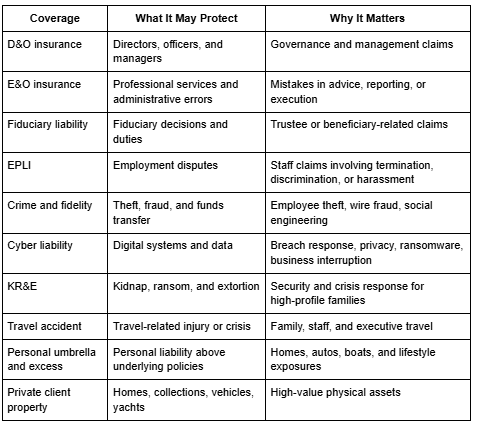
How Harbour Insurance Agency Helps Family Offices Compare Coverage
Harbour Insurance Agency is an independent insurance agency helping high-net-worth Florida families and family offices review insurance needs and compare coverage options from reputable carriers.
Because Harbour is not tied to a single carrier, coverage comparisons reflect what is actually available across the market rather than what one company’s product lineup includes. That matters for family offices, where the right structure may involve multiple carriers, multiple policy types, and coordination across personal, entity, and specialty exposures.
Harbour can help clients:
-
Map personal, entity-level, household, cyber, and specialty exposures
-
Review existing private client policies for gaps and outdated limits
-
Compare family office insurance options from carriers
-
Coordinate D&O, E&O, fiduciary liability, cyber, crime, and EPLI discussions
-
Review personal umbrella and excess liability needs
-
Coordinate coverage for homes, autos, yachts, collections, and household staff
-
Identify gaps between personal policies and family office operations
-
Support conversations with attorneys, CPAs, wealth advisors, trustees, and cybersecurity professionals
-
Build an annual insurance review process around family office changes
Coverage availability, limits, exclusions, and policy terms vary by carrier and individual circumstances. Risk management should be coordinated with legal, tax, investment, and cybersecurity advisors.
Family office risk management requires coordination across people, property, governance, technology, and wealth. Speak with a Harbour advisor or request a policy review to compare coverage options for your Florida family office and broader private client insurance program.
Frequently Asked Questions
What insurance does a family office need?
A family office may need private client insurance, personal umbrella or excess liability, D&O, E&O, fiduciary liability, EPLI, cyber liability, crime and fidelity, kidnap and ransom, travel accident, valuable articles, domestic staff coverage, and specialty property coverage. The right program depends on the office structure, family risk profile, and whether the office is standalone or embedded.
What is family office insurance?
Family office insurance is a coordinated insurance program designed to protect the family office entity, family members, employees, directors, officers, trustees, assets, cyber systems, and operations. It addresses both personal wealth exposures and entity-level liabilities that personal policies do not cover.
Does a family office need D&O insurance?
Many family offices should review D&O insurance because directors, officers, managers, or committee members may face claims related to governance, management decisions, conflicts of interest, or alleged mismanagement. Personal assets can be at risk in the absence of entity-level D&O coverage.
Does a family office need E&O insurance?
A family office may need E&O or professional liability insurance if it provides administrative, investment-related, reporting, concierge, accounting, or advisory services that could lead to claims of errors or omissions resulting in financial harm.
Does a family office need fiduciary liability insurance?
Fiduciary liability should be reviewed when family office executives, trustees, committees, or staff have duties involving trusts, benefit plans, beneficiaries, or asset oversight. The exposure can be personal even when decisions are made in good faith.
Does a personal umbrella policy cover a family office?
Generally no. Personal umbrella insurance is designed for personal liability exposures such as home, auto, or watercraft claims. It does not cover entity-level professional, fiduciary, employment, cyber, or management liability risks.
What cyber insurance does a family office need?
A family office typically needs both personal cyber insurance for family members and business cyber liability coverage for the entity. Entity-level coverage should address breach response, ransomware, social engineering, funds transfer fraud, privacy liability, data restoration, and business interruption.
What is crime insurance for a family office?
Crime insurance, also called fidelity coverage, may help protect against employee theft, forgery, funds transfer fraud, social engineering fraud, and other financial crimes. It is particularly important for family offices that regularly handle large transactions and wire transfers.
How often should a family office review insurance?
At least annually, and after any significant change: a liquidity event, new property purchase, family move, new trust, new employee, cyber system change, major travel pattern shift, new yacht or aircraft, or estate plan update.
What is the difference between private client insurance and family office insurance?
Private client insurance protects personal assets and lifestyle exposures such as homes, vehicles, collections, yachts, personal liability, cyber, and identity theft. Family office insurance also protects the office entity, employees, management decisions, fiduciary duties, professional services, and operations.
Does a family office need EPLI?
If the family office employs staff, EPLI can help respond to claims involving wrongful termination, discrimination, harassment, retaliation, and other employment-related allegations. This applies to office employees and may extend to household staff depending on the employment structure.
Can Harbour Insurance Agency help with family office insurance?
Yes. Harbour Insurance Agency can help high-net-worth Florida families and family offices review current coverage, identify gaps, and compare family office insurance options from reputable carriers.
Ready to review your family office coverage? Request an insurance quote or request a policy review to compare family office insurance options from trusted Florida carriers. Coverage availability and terms vary by carrier and individual circumstances.




