

Florida enforces some of the strictest workers compensation requirements in the country, and the penalties for non-compliance are among the harshest. Construction employers need coverage from the very first employee. Most non-construction businesses must carry it at four or more employees. Agriculture has its own separate thresholds. And if you fall out of compliance, the Florida Division of Workers’ Compensation can issue a stop-work order that shuts your business down immediately, along with a penalty equal to twice the premium you should have been paying.
Understanding these rules isn’t optional for Florida employers; it’s the baseline. From there, the question becomes how to structure coverage that meets your legal obligations, protects your employees, and doesn’t cost more than it should. That means getting your class codes right, managing your experience modification factor, and working with a broker who understands how Florida’s workers comp system prices risk across different industries.
Key Takeaways:
-
Florida construction employers need workers compensation coverage from the first employee, while most non-construction businesses must carry it at four or more employees (full or part time).
-
Premiums are driven by payroll, NCCI class code, and your experience modification factor, and the same job classification can produce very different rates depending on how your claims history compares to industry peers.
-
Non-compliance can trigger a stop-work order halting business operations and a penalty equal to twice the premium the employer avoided, plus daily fines until the order is released.
-
Pay-as-you-go policies help seasonal employers match premium payments to actual payroll, reducing cash flow strain and audit surprises.
-
Corporate officers and LLC members can file exemptions in some cases, but the limits on how many may exempt are stricter in construction than in other industries.
See how workers comp fits your full coverage program on our insurance solutions page.
How Many Employees Trigger Workers Comp in Florida Businesses?
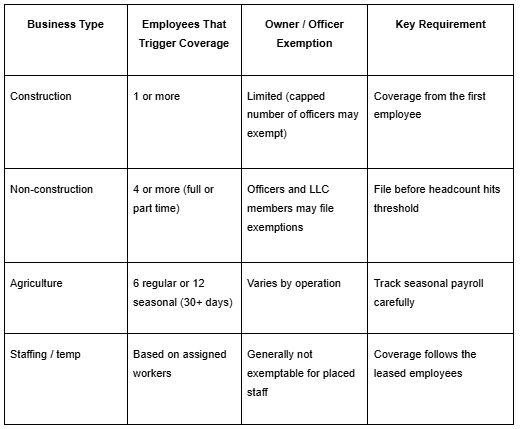
Florida’s coverage thresholds vary by industry, and the rules are stricter than most states. Construction employers must carry workers compensation from the moment they hire their first employee, regardless of whether that person is full-time, part-time, or family. Non-construction businesses are required to carry coverage once they reach four or more employees (counting full-time and part-time equally). Agriculture operates on a separate schedule entirely.
Highlight Box: Florida Workers’ Comp Coverage Thresholds by Business Type
Note: Thresholds are based on current Florida Division of Workers’ Compensation rules. Verify current requirements, as rules can change.
The construction threshold is the one that catches employers most often. A general contractor who hires one laborer, even part-time, must carry workers comp or face enforcement action. And uninsured subcontractors are typically treated as your employees under Florida law, which means their payroll can be added to your policy at audit if they can’t produce a certificate of insurance.
What Are Workers Comp Requirements for Florida Small Employers?
Florida requires covered employers to purchase workers compensation through a licensed insurance carrier or approved self-insurance program. The coverage must meet the state’s statutory benefit levels, which include medical benefits, temporary total disability (TTD) payments, and permanent impairment benefits for employees injured on the job.
Corporate officers in non-construction businesses can file exemption certificates with the Florida Division of Workers’ Compensation, and LLC members may exempt themselves as well. However, construction officers face stricter limits: only a specified number of officers per corporation can exempt. If you’re relying on exemptions to stay below the coverage threshold, confirm that your filings are current, because an expired or improperly filed exemption can put you out of compliance without warning.
The U.S. Small Business Administration provides a general overview of small business insurance requirements, and the Florida Department of Financial Services offers state-specific guidance.
Visit our Service Center for help with certificates, exemptions, and audit preparation.
Florida Workers’ Comp Coverage by Employer Type
Workers compensation insurance for Florida construction employers
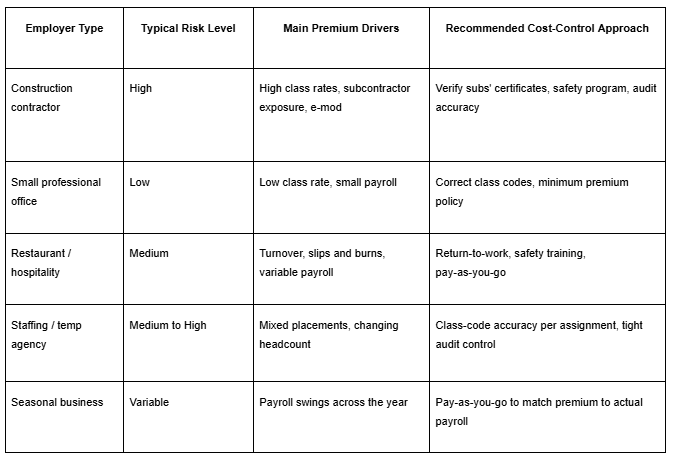
Construction employers face the broadest coverage mandate in Florida: one employee triggers the requirement. The rates are among the highest in any industry because construction work involves falls, heavy equipment, power tools, and structural hazards that generate frequent and severe claims. A small framing crew or roofing company can expect to pay $5 to $15+ per $100 of payroll depending on the specific trade classification.
Subcontractor management is equally important. Florida law requires general contractors to verify that every subcontractor carries workers comp coverage. If a sub doesn’t have it, their workers may be treated as your employees for coverage purposes, and the premium for their payroll gets added to your policy at the next audit.
Florida workers comp coverage for small professional offices
Small professional offices (law firms, accounting practices, consulting firms, medical offices) fall under the non-construction threshold, meaning coverage is required at four or more employees. The rates for clerical and professional class codes are among the lowest in the system, often below $0.50 per $100 of payroll, which makes workers comp one of the most affordable coverages these businesses carry.
Even at low rates, getting the class codes right matters. An employee who splits time between office work and field visits may need to be classified under a higher-rate code for the non-office portion, and failing to report this accurately can create audit problems.
Workers comp insurance for Florida restaurants and hospitality
Florida’s restaurant and hospitality industry falls in the moderate range for workers comp rates, but the combination of high turnover, physically demanding work, and kitchen hazards (burns, cuts, slips) creates consistent claims activity. Pay-as-you-go billing is particularly useful for restaurants because staffing levels fluctuate seasonally and with tourism patterns.
Implementing documented safety training for kitchen staff, servers, and housekeeping teams can reduce claim frequency and improve your experience modification factor over time, which directly lowers your premium at renewal.
Florida workers compensation for staffing and temp agencies
Staffing agencies in Florida carry workers comp coverage for the employees they place, and the premium is driven by the class codes of the assignments rather than the agency’s own office operations. A staffing firm that places workers in both clerical roles and warehouse positions will pay very different rates for each placement type.
Accurate class-code assignment per placement is the single most important cost-control lever for staffing agencies, because misclassifying a warehouse worker under an office code creates compliance risk, while misclassifying an office worker under a warehouse code inflates the premium.
Pay-as-you-go workers comp for Florida seasonal businesses
Seasonal businesses in Florida (tourism operators, landscaping companies, agricultural operations, event-based businesses) face a common problem: estimating annual payroll at the beginning of the policy term is difficult when staffing levels swing dramatically by season. Pay-as-you-go workers comp solves this by calculating premium on actual payroll each pay period, which aligns your costs with your real workforce and prevents the large year-end audit adjustment that catches many seasonal employers off guard.
Highlight Box: Premium Drivers and Cost-Control by Florida Employer Type
Tell us your industry and payroll and we’ll size your policy. Request a quote from Harbour Insurance Agency.
How Are Florida Workers Comp Premiums Calculated for Employers?
Florida workers comp premiums follow a formula that applies to every employer in the state, though the inputs vary by industry and individual claims history. The calculation works in five steps:
-
Classify each employee by NCCI class code based on their actual job duties.
-
Total the annual payroll for each class code.
-
Multiply (payroll / 100) by the class rate for that code.
-
Apply the experience modification factor (e-mod) to the result.
-
Add any state surcharges or carrier credits to reach the final premium.
The formula itself is straightforward. What makes it complex in practice is the number of variables: a business with five different job types has five different class rates, and each rate is adjusted by the same e-mod. Getting the class codes right at the front end prevents overpayment throughout the policy term and reduces the risk of a costly surprise at audit.
Florida uses NCCI class codes and rates as the starting point, though individual carriers can apply schedule credits and debits based on their own underwriting assessment of your risk. This is where working with an independent agent who compares multiple carriers produces real value, because the same employer can receive meaningfully different quotes from different carriers based on how each one assesses the risk.
Which Occupations in Florida Have the Highest Workers Comp Rates?
The highest-rate occupations in Florida share common characteristics: physically demanding work, exposure to falls or heavy equipment, and a history of severe and costly claims. Roofing consistently ranks at or near the top, with rates that can exceed $15 to $25 per $100 of payroll. Structural steel erection, tree trimming, and heavy trucking follow closely.
These rates reflect actual claims data. The Bureau of Labor Statistics tracks workplace injuries and illnesses by industry, and the occupations with the highest workers comp rates correlate closely with the industries that report the most frequent and severe injuries. For employers in these trades, the premium represents a significant percentage of total labor cost, which makes claim prevention and experience mod management essential rather than optional.
How Can Florida Employers Reduce Workers Compensation Costs?
Reducing workers comp costs in Florida requires a combination of operational discipline and insurance strategy. The employers who pay the least relative to their peers are typically the ones who manage claims proactively rather than simply paying the premium and hoping for the best.
-
Run a documented workplace safety program with regular training, hazard assessments, and accountability. OSHA provides free resources for building safety programs tailored to specific industries.
-
Implement a return-to-work plan that gets injured employees back to modified duty quickly, which shortens claims and reduces their impact on your experience modification factor.
-
Verify every subcontractor’s certificate of insurance so their uninsured payroll doesn’t land on your policy at audit.
-
Audit your class codes annually to ensure no payroll is misclassified into higher-rate categories.
-
Manage your experience mod by focusing on claim frequency, because multiple small claims raise the mod more than a single large one.
-
Use pay-as-you-go billing to protect cash flow and eliminate large year-end audit surprises.
Learn about our agency and how we help Florida employers reduce workers comp costs through carrier comparison and class-code audits.
What Happens If You Don’t Carry It: Florida Penalties
Florida takes workers comp enforcement seriously, and the consequences of non-compliance are severe enough to threaten the viability of a business.
-
Stop-work order halting all business operations until compliance is achieved.
-
Penalty equal to twice the premium the employer avoided during the period of non-compliance.
-
Daily fines accumulating until the stop-work order is released.
-
Personal and business liability for all injury costs that would have been covered by a policy.
-
Reputational damage and loss of contract eligibility with clients who require certificates of insurance.
The Florida Division of Workers’ Compensation enforces employer compliance, and the construction industry receives particular scrutiny. A stop-work order posted at your job site doesn’t just cost money; it costs projects, client relationships, and your ability to bid future work.
If you have a compliance gap that needs to be resolved quickly, contact Harbour Insurance Agency or call (239) 354-4053. We can often bind coverage and issue certificates within the same business day.
Get the Right Workers Compensation Insurance Florida Employers Need with Harbour Insurance Agency
In Florida, coverage is not optional once you cross your industry threshold, and the penalty for guessing wrong is a stop-work order that shuts down your operation. The employers who overpay on workers comp are usually misclassified or carrying a bad experience mod, not simply operating in high-risk industries. Both problems are fixable with a proper audit and a proactive approach to claims management.
The most effective steps you can take right now: confirm your threshold and exemption status, verify that your class codes accurately reflect your employees’ actual job duties, and request a right-sized quote that reflects your real payroll rather than an outdated estimate.
Harbour Insurance is an independent agency that compares multiple workers comp carriers and audits class codes so Florida employers don’t overpay. Request a quote or contact our team to get started. You can also call us directly at (239) 354-4053.
Frequently Asked Questions About Workers Compensation Insurance in Florida
What happens if a Florida employer does not carry workers comp?
The state can issue a stop-work order shutting down operations and assess a penalty equal to twice the premium the employer avoided, plus daily fines until compliance is achieved. Injury costs that would have been covered by a policy become the employer’s personal liability.
Are corporate officers required to be covered in Florida?
Officers can often file an exemption, but Florida limits how many officers may exempt per corporation, and the limits are stricter in construction than in other industries. Non-exempt officers must be included in coverage.
Do 1099 contractors need workers comp in Florida?
In construction, uninsured subcontractors are typically treated as your employees for coverage purposes, so their payroll can be added to your policy at audit. Verifying certificates of insurance for every sub is essential to avoid unexpected premium increases.
How does a pay-as-you-go workers comp policy work?
Premium is calculated on actual payroll each pay period instead of an upfront annual estimate, which smooths cash flow and reduces the large audit adjustments that surprise many employers at the end of the policy term. This structure is particularly useful for seasonal Florida businesses.
What is an experience modification factor and how does it affect my premium?
The e-mod compares your claim history to similar businesses in your class. A factor below 1.0 lowers your premium; above 1.0 raises it. Reducing claim frequency through safety programs and return-to-work plans is the most direct way to improve your mod over time.
Harbour Insurance Agency is an independent insurance agency helping Florida employers navigate workers compensation requirements, compare carrier rates, and structure cost-effective coverage. Our agents audit class codes, manage exemption filings, and build programs tailored to Florida’s industry-specific thresholds and enforcement standards.