

General liability insurance cost is one of the first questions small business owners ask when setting up coverage, and the answer varies more than most people expect. A home-based consultant might pay $25 per month while a general contractor pays $200 or more, and both are getting appropriate coverage for their risk profiles. The difference comes down to what you do, how much revenue you generate, and how much exposure your business creates for third-party injury or property damage claims.
For most small businesses in the United States, general liability insurance (also called commercial general liability, or CGL) costs between $300 and $1,500 per year, with the national median landing around $500 to $700 annually. Those figures shift significantly once you factor in industry, location, coverage limits, and claims history. Understanding what drives the premium helps you evaluate whether your current policy is priced fairly and where you might reduce cost without creating dangerous gaps.
Key Takeaways:
-
Most small businesses pay between $30 and $100 per month for general liability insurance, with annual premiums typically ranging from $300 to $1,500 depending on industry, revenue, and coverage limits.
-
Price is driven primarily by industry risk classification, annual revenue or payroll, coverage limits, and claims history, not company size alone.
-
Bundling general liability into a business owners policy (BOP) often lowers total cost by packaging GL with commercial property coverage at a combined rate.
-
General liability is different from professional liability (errors and omissions), and many businesses need both to cover the full range of third-party claims.
-
Getting an accurate quote requires your annual revenue, business type, states of operation, and desired limits.
Get a general liability quote from Harbour Insurance Agency.
How Much Does General Liability Insurance Typically Cost?
For a small business with moderate risk and standard coverage limits, general liability insurance typically costs $400 to $800 per year, or roughly $35 to $70 per month. Businesses in higher-risk industries (construction, manufacturing, trades) pay more, while low-risk professional and home-based businesses pay less. The Insurance Information Institute provides additional context on business liability coverage types and typical pricing structures.
Average general liability premium for small business owners
The average general liability premium for a US small business falls in the range of $500 to $700 per year, though “average” is a misleading number because the range extends from under $300 for a solo consultant to $2,500 or more for a general contractor. Industry is the single largest variable. A retail store with customer foot traffic pays more than an online-only business because the physical premises create slip-and-fall exposure that an e-commerce operation doesn’t have.
Is general liability insurance paid monthly or annually?
Both options are available from most carriers. Paying annually typically saves 5% to 10% compared to monthly installments because carriers apply a financing charge to monthly billing. For businesses watching cash flow closely, monthly payments spread the cost but increase the total amount paid over the policy term. Some carriers also offer quarterly or semi-annual billing as a middle ground.
What Factors Affect General Liability Insurance Premiums Most?
Seven factors determine your general liability premium:
-
Industry and risk class of your trade
-
Business size (revenue, payroll, or square footage, depending on the exposure basis)
-
Coverage limits and deductible selected
-
Claims history and years in operation
-
Location and local litigation climate
-
Number of employees
-
Whether coverage is standalone or bundled into a BOP
Explore our business insurance solutions to see how these factors apply to your specific business type.
What does general liability insurance cover?
General liability insurance covers third-party claims for bodily injury (a customer slips and falls at your business), property damage (your work damages a client’s property), and personal and advertising injury (libel, slander, or copyright infringement in your advertising). It also covers legal defense costs associated with these claims, which can be substantial even when the underlying claim is ultimately dismissed.
It does not cover employee injuries (that’s workers compensation), professional mistakes (that’s professional liability/E&O), auto accidents (that’s commercial auto), or damage to your own property (that’s commercial property insurance). Understanding what GL covers and what it doesn’t prevents the assumption gaps that leave businesses exposed.
How much coverage does a small business need?
Most small businesses carry per-occurrence limits of $1,000,000 and general aggregate limits of $2,000,000, which is the standard structure that satisfies most lease agreements, client contracts, and licensing requirements. Businesses with higher exposure (construction, manufacturing, event services) may need higher limits or a commercial umbrella policy that provides additional protection above the GL limits.
The U.S. Small Business Administration provides guidance on business insurance requirements for small business owners.
Highlight Box: What Drives Your Premium and How to Influence It
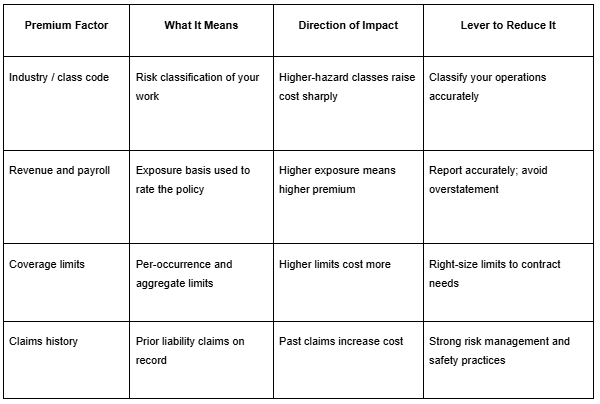
General Liability Insurance Cost by Business Type
Highlight Box: Cost by Business Type (Estimates)
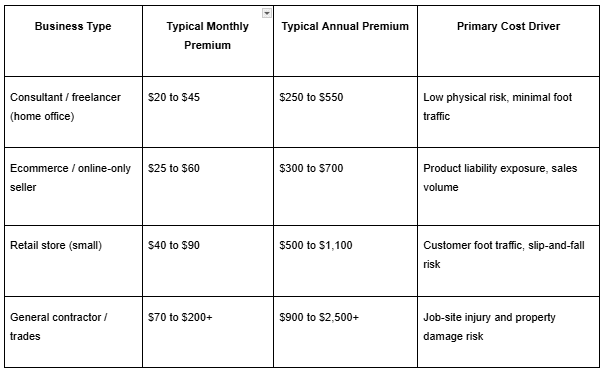
Note: Figures are estimates. Actual premiums vary by state, carrier, revenue, and claims history.
General liability insurance cost for independent contractors
Independent contractors and freelancers often pay the lowest general liability premiums because their work typically involves lower physical risk and limited client-facing exposure. However, many clients require contractors to carry GL as a condition of the contract, and a certificate of insurance (COI) showing adequate limits is often the price of admission to a project. For contractors, GL isn’t just about risk management; it’s about marketability.
General liability cost for consultants and freelancers
Consultants and freelancers working from home offices represent the lowest-cost end of the GL spectrum, with many paying under $500 per year. The premium reflects minimal premises exposure and limited property damage risk. However, consultants should understand that GL does not cover claims arising from their professional advice or services. That exposure requires professional liability (E&O) coverage, which is a separate policy.
GL insurance pricing for ecommerce and online-only businesses
Online businesses without a physical storefront pay less for general liability than brick-and-mortar retailers because they don’t have customer foot traffic creating premises liability. However, businesses that sell physical products carry product liability exposure under their GL policy, which means the premium scales with sales volume. An online seller doing $500,000 in annual revenue pays more than one doing $50,000 because the product liability exposure is larger.
Low-cost general liability policies for new micro businesses
Startups and micro businesses (sole proprietors, single-member LLCs, small partnerships) can often secure GL coverage for $300 to $500 per year with standard limits. Many carriers offer minimum-premium policies designed for businesses with low revenue and limited exposure. The cost is modest enough that carrying GL from day one is a straightforward decision for most new businesses, especially since many landlords, clients, and licensing bodies require it.
Why businesses choose our independent agency for general liability: we compare multiple carriers to find the best rate for your business type and revenue level.
Which Industries Pay the Highest General Liability Rates?
Industries with the highest GL rates share common characteristics: significant physical contact with the public, work performed on third-party property, and higher probability of bodily injury or property damage claims. Construction and trades consistently pay the most, followed by janitorial and cleaning services, landscaping, manufacturing, and event services.
The rate disparity between a home-based consultant and a roofing contractor can be 10x or more, which is why industry classification is the single most important factor in GL pricing. If your business spans multiple activities (for example, a contractor who also does consulting), accurate classification ensures you’re not paying the higher rate on revenue that belongs in a lower-risk category.
How Startups Can Estimate Their General Liability Budget
Five numbers to have ready for an accurate quote:
-
Annual revenue (projected for startups)
-
Annual payroll (if you have employees)
-
Business type and class code
-
States of operation
-
Desired coverage limits (start with $1M/$2M if unsure)
General liability insurance cost for an LLC
Forming an LLC doesn’t change your GL premium, but it also doesn’t eliminate your need for it. An LLC provides some personal liability protection, but it doesn’t shield you from third-party injury or property damage claims that a GL policy covers. A customer who slips at your business can sue the LLC, and without GL coverage, the LLC’s assets (and potentially your personal assets if the corporate veil is pierced) are at risk. The cost of GL for an LLC is driven by the same factors as any other business structure: industry, revenue, and limits.
Use our Service Center to review limits and certificates on your current policy.
How to Get Cheaper General Liability Insurance Without Coverage Gaps
Six ways to lower general liability cost without creating dangerous gaps:
-
Bundle into a business owners policy (BOP) to combine GL and commercial property at a lower total cost.
-
Right-size your limits to your actual contract and lease requirements rather than over-insuring.
-
Raise the deductible if you can absorb small claims out of pocket.
-
Pay annually instead of monthly to avoid financing charges.
-
Ensure your business is accurately classified so you’re not paying a higher-risk rate unnecessarily.
-
Compare multiple carriers through an independent agent, because GL pricing varies significantly between insurers for the same risk.
Talk to a licensed agent about the right limits and how bundling might reduce your total cost. Compare bundled BOP pricing through Harbour Insurance Agency.
Control General Liability Insurance Cost with Harbour Insurance Agency
General liability cost comes down to three things: your industry classification, your exposure basis (usually revenue or payroll), and the limits you choose. Most small businesses can lower their total cost by bundling GL into a business owners policy, which combines GL and commercial property at a rate that’s typically less than buying each separately.
Harbour Insurance is an independent agency that compares multiple carriers and right-sizes limits so businesses avoid both overpaying for coverage they don’t need and carrying gaps that leave them exposed. Our recommendation: get a BOP quote alongside a standalone GL quote and compare the total cost. For many small businesses, the BOP wins on both price and coverage breadth.
Learn more about our agency and experience. Ready to compare? Request your general liability quote today or call us at (239) 354-4053.
Frequently Asked Questions About General Liability Insurance Cost
Is general liability cheaper in a business owners policy (BOP)?
Yes, in most cases. A BOP bundles general liability and commercial property into a single policy, and the combined premium is typically 10% to 20% less than purchasing each coverage separately. BOPs are designed for small businesses and are available from most carriers.
Does general liability insurance require a deductible?
It depends on the policy. Many small business GL policies have no deductible for liability claims, meaning the insurer covers defense and settlement from the first dollar. Some policies do include a per-occurrence deductible, particularly for higher-risk classes. Check your specific policy terms.
How fast can I get a certificate of insurance (COI)?
In most cases, a COI can be issued within hours once the policy is bound. If you need proof of coverage for a contract or lease deadline, contact us and we can expedite the process.
Can I get general liability insurance the same day?
Yes. Many carriers can bind coverage and issue a policy on the same day for straightforward small business risks. Contact Harbour Insurance at (239) 354-4053 to get started.
Does general liability cover professional mistakes or bad advice?
No. General liability covers bodily injury, property damage, and advertising injury. Claims arising from professional errors, negligent advice, or failure to perform services require a separate professional liability (E&O) policy. Many businesses need both.
What happens to my premium at the annual audit?
Your carrier will compare your actual revenue or payroll against the estimates used to set the original premium. If actual figures were higher, you’ll owe additional premium. If lower, you may receive a refund. Accurate reporting at the start of the policy term minimizes audit surprises.
Harbour Insurance Agency is an independent insurance agency helping businesses find competitive general liability coverage across multiple carriers. Our agents compare rates, right-size limits, and identify bundling opportunities that reduce total cost without creating coverage gaps.




