

Insurance is one of the largest operating expenses for any golf course, and it varies dramatically depending on what you’re actually running. A modest 9-hole municipal course with a basic pro shop faces a completely different cost structure than a 36-hole private resort with multiple restaurants, a banquet facility, and a full tournament schedule.
Both need coverage, but the scope, limits, and pricing reflect very different risk profiles, and understanding what drives those differences helps you budget accurately and evaluate whether you’re paying a fair price.
Think of golf course insurance cost the way you’d think about maintaining the course itself: a municipal track with basic infrastructure needs less investment than a resort-quality layout with bentgrass greens, a state-of-the-art irrigation system, and a full-service clubhouse. The insurance mirrors the operational complexity.
Key Takeaways:
-
Golf course insurance typically costs $25,000 to $150,000+ annually, with the range driven by acreage, revenue, operational complexity, and location-specific risks like hurricane exposure.
-
Liquor liability and event hosting can increase premiums by 15% to 40%, making food and beverage operations one of the most significant cost drivers beyond base property and liability.
-
Active risk management (safety programs, staff training, maintenance documentation) can reduce premiums by approximately 10% to 25%, making it one of the most effective cost-control strategies available.
-
Course type matters significantly: municipal courses typically pay $25,000 to $50,000, private clubs $50,000 to $100,000, and resorts $100,000 to $150,000+.
Request a tailored quote based on your course profile through Harbour Insurance Agency.
How Much Does Golf Course Insurance Cost
Golf course insurance costs vary widely because the premium reflects far more than the land itself. Insurers price the full operation, including property values, liability exposure, food and beverage activity, equipment, event hosting, and regional weather risk, which is why meaningful cost comparisons have to account for the way the course actually operates.
Average Annual Cost Ranges
Highlight Box: Golf Course Insurance Cost by Type
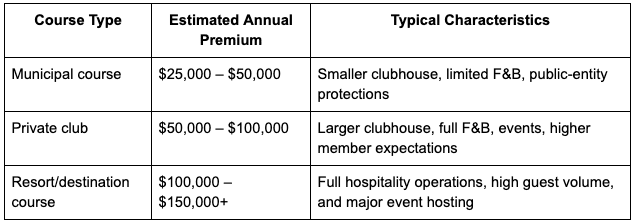
These ranges reflect comprehensive programs including property, general liability, liquor liability, equipment, and basic event coverage. Courses at the higher end of each range typically have larger properties, higher revenues, more extensive food and beverage operations, or greater weather exposure. Individual premiums can fall outside these ranges depending on specific risk factors, claims history, and the coverage limits selected.
Golf Course Insurance Cost Breakdown by Acreage and Revenue
Acreage and revenue are two of the clearest indicators of insurance cost because they capture both the physical scale of the property and the volume of business activity taking place on it. One speaks to the amount of infrastructure and grounds exposure that must be insured, while the other helps insurers measure how much guest traffic, operational activity, and liability risk the course generates.
Cost by Acreage
More land doesn’t just mean more grass. It means more infrastructure (irrigation systems, cart paths, bridges, drainage), more terrain-related hazards (water features, elevation changes, wooded areas), more maintenance equipment operating across a larger footprint, and more potential points of liability spread across a wider area. A compact 100-acre course has a smaller physical footprint to insure than a sprawling 300-acre facility with multiple courses, practice ranges, and buffer zones.
Property coverage, which is priced in part on the replacement cost of all physical improvements, scales directly with the extent and value of course infrastructure. Two courses with the same annual revenue but significantly different acreage will see meaningfully different property premiums because the physical exposure is larger.
Cost by Revenue
Revenue is one of the primary rating factors insurers use because it correlates with business volume, guest count, and overall liability exposure. A course generating $2 million in annual revenue is processing more rounds, serving more food and drinks, hosting more events, and interacting with more guests than one generating $500,000, and each of those activities creates its own claim potential.
Higher revenue also typically means higher property values (better-maintained clubhouse, more equipment, nicer facilities), which increases the property component of the premium independently of the liability component.
Impact of Clubhouse, Restaurant, and Pro Shop
The clubhouse and its associated operations often represent a significant portion of both property value and liability exposure at a golf course. A full-service clubhouse with a restaurant, bar, banquet room, and pro shop adds substantial cost to the insurance program in multiple categories: more square footage to insure against property damage, food safety exposure from kitchen operations, liquor liability from alcohol service, retail inventory risk from the pro shop, and event liability from private functions and banquets.
For some courses, the clubhouse operations generate as much insurance cost as the golf course itself, which is a fact that surprises many operators who think of insurance primarily in terms of the course rather than the building.
What Factors Affect Golf Course Insurance Premiums
Golf course insurance premiums are shaped by a combination of location, operating model, claims experience, and the specific features that increase either property exposure or liability risk. Even courses with similar layouts can see very different pricing if one serves alcohol, hosts frequent events, or operates in a region with higher catastrophe exposure.
Location
Geographic risk is one of the largest premium drivers. A golf course in Florida faces hurricane, flood, and lightning exposure that an inland Midwest course doesn’t contend with. Coastal courses in hurricane-prone states pay significantly more for property coverage due to wind and storm surge risk, and this premium differential can represent tens of thousands of dollars annually.
Claims History
A clean claims record is one of the most effective ways to keep premiums low. Carriers review your loss history for the past five to seven years, and courses with frequent or severe claims see measurably higher premiums at each renewal.
Number of visitors and Members
Guest volume directly affects liability exposure. More people on the property means more opportunities for injuries, incidents, and claims, which is why high-traffic courses pay more for liability coverage even if their physical property is similar to a lower-traffic competitor.
Alcohol Service
Courses that serve alcohol, particularly those with bar and restaurant operations, face elevated liability that insurers price aggressively. Liquor liability is one of the most claim-intensive coverage types in the hospitality industry, and the premium reflects that reality.
Events
Regular tournament and event hosting creates concentrated liability exposure. The frequency, size, and nature of events (corporate outings, charity tournaments, weddings, holiday parties) all affect premium calculations.
Property Value and Infrastructure
The total replacement cost of all structures, equipment, irrigation systems, and course improvements determines the property coverage component of the premium. Courses that haven’t updated their insured values in several years are often underinsured relative to current construction costs.
What Insurance Coverage Does a Golf Course Need
Golf courses need general liability covering guest injuries and premises liability across all areas of the property. Property insurance covering all structures and equipment at current replacement cost. Liquor liability for alcohol-related claims if you serve any alcohol in any capacity. Equipment and golf cart coverage for the fleet and specialized maintenance machinery. Event coverage for tournaments, outings, weddings, and other gatherings hosted on the property.
For a deeper look at coverage types and how to evaluate providers, explore our business insurance solutions at Harbour Insurance.
How Liquor Liability and Events Impact Cost
Liquor service and event hosting can materially increase golf course insurance costs because both create concentrated liability exposure that standard premises risk does not fully capture. When alcohol, large guest groups, and private functions are part of the operation, insurers expect a higher likelihood of claims and price that added exposure accordingly.
Highlight Box: Liquor and Event Premium Impact
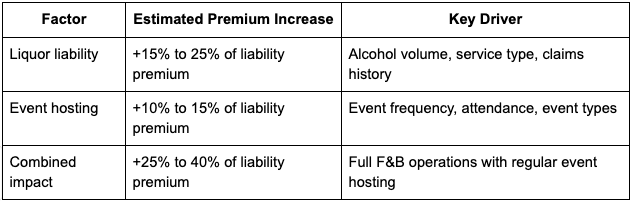
Liquor liability can increase the overall liability premium by 15% to 25%, depending on alcohol volume, service type (full bar versus beer and wine only), and whether the course operates a standalone restaurant or banquet facility. Event hosting adds another 10% to 15% based on frequency and typical attendance.
Combined, liquor and event exposure can increase the liability component by 25% to 40% above what it would cost for a course that served no alcohol and hosted no outside events. That’s a significant premium multiplier, but it reflects genuine risk: alcohol-related claims and event injuries are among the most frequent and expensive claim categories in golf course insurance.
Contact our team or call (239) 354-4053 to assess how your specific food, beverage, and event operations affect your premiums.
How Deductibles and Coverage Limits Affect Cost
A higher deductible means a lower premium, but only if the policyholder can comfortably absorb that amount when a claim occurs. Moving from a $5,000 to a $25,000 property deductible can meaningfully reduce costs, but a $25,000 out-of-pocket expense after a storm needs to be manageable within your operating budget.
It’s also worth considering different deductible levels for different coverage types. A higher property deductible may make sense if weather claims are infrequent at your location, while a lower liability deductible may be worth the additional premium if guest injuries are a regular occurrence. Your broker can model these scenarios to show you exactly how different deductible structures affect both your premium and your out-of-pocket exposure at each level.
Lower limits are cheaper but riskier. Reducing liability limits saves premium dollars but increases the amount of uninsured exposure your business carries. For liability in particular, inadequate limits can be catastrophic if a serious guest injury or alcohol-related incident generates a claim that exceeds your coverage. The goal is to find the balance point where you’re not overpaying for limits you’ll never need, but you’re also not exposed to a claim that could threaten the business.
How to Reduce Golf Course Insurance Costs
Safety and maintenance programs: Documented safety protocols, regular equipment maintenance, hazard identification and remediation, and property upkeep all demonstrate to insurers that you’re actively managing risk. Carriers reward proactive risk management with better pricing because it directly reduces claim frequency and severity.
Staff training: Alcohol service training (TIPS certification or equivalent), golf cart safety training for both staff and guests, CPR/first aid certification for key personnel, and emergency response protocols all reduce the likelihood and severity of claims. These certifications also demonstrate professionalism that carriers factor into pricing.
Limiting high-risk activities.: If certain activities generate disproportionate claims (a specific event format, an unusually hazardous course feature, or a high-traffic area with recurring incidents), modifying or addressing them can reduce premiums at your next renewal.
Bundling policies: Combining property, liability, liquor, equipment, and event coverage into a single program through one carrier typically produces pricing advantages over purchasing each type separately from different providers.
Comparing multiple quotes: This is the single most effective cost-reduction strategy. Golf course insurance pricing varies significantly between carriers, and a broker who quotes the market broadly will almost always find better terms than a single-carrier approach. The difference between the highest and lowest quote for the same course can be 30% or more.
Cost Benchmarks by Course Type
Municipal courses tend to have the lowest premiums because they typically have smaller clubhouses, limited food and beverage operations, lower property values, and public-entity protections that reduce certain liability exposures. Their insurance programs are simpler because the operational complexity is lower.
Private clubs occupy the middle range. They have more valuable clubhouses, more extensive food and beverage operations, higher member expectations (and corresponding litigation tendencies), and more events. But they also tend to have more controlled access and smaller guest populations than public courses, which partially offsets the increased complexity.
Resort and destination courses sit at the top of the cost range. They combine the most expensive properties, the highest guest volumes (including transient guests unfamiliar with the course), full-service hospitality operations, and event hosting that may include conferences, weddings, and multi-day tournaments. In hurricane-prone locations like Florida, the weather component adds significantly to the total.
How to Compare Golf Course Insurance Quotes
Verify that quotes reflect comparable limits across all coverage types, because a lower premium often means lower limits rather than better pricing. A quote that’s 20% cheaper but carries half the liability coverage isn’t actually saving you money; it’s transferring risk from the insurer back to you.
Identify exclusions in each policy and assess whether they create meaningful gaps in your protection. Pay particular attention to weather-related exclusions (especially in hurricane-prone states), mold limitations, and equipment breakdown provisions. Compare deductible structures across property and liability coverages, since different deductible levels can make seemingly similar premiums produce very different out-of-pocket exposure when a claim occurs.
Determine whether the quoting carrier has specific experience insuring golf courses rather than applying a generic commercial template. A carrier that understands golf operations will price risk more accurately and design coverage that reflects how your course actually operates, rather than forcing your operation into a framework designed for office buildings or retail stores.
Visit our Service Center for help comparing quotes from multiple providers.
Premium Financing Options
Monthly payment plans spread the cost over the policy term with a modest financing charge, which preserves cash flow for seasonal operations like spring course preparation, summer staffing ramp-ups, and capital improvement projects. For courses with seasonal revenue patterns, spreading insurance costs monthly can ease the cash flow pressure that comes with paying a large annual premium in a single installment.
Annual payment usually provides a 3% to 5% discount compared to financed payments. For courses with strong cash positions, paying annually reduces total insurance cost. The right choice depends on your cash flow patterns and the opportunity cost of tying up capital in insurance premiums versus deploying it in operations or improvements.
Are There Specialized Golf Course Insurance Providers
Yes. The commercial insurance market includes carriers that specifically underwrite golf courses, country clubs, and related hospitality operations. These niche carriers understand the industry’s unique risk profile and offer products designed specifically for it, with coverage terms and exclusions that reflect golf course claims patterns rather than generic commercial assumptions.
Harbour Insurance Agency helps golf course operators access these specialized markets by comparing options from multiple carriers, including both niche golf and hospitality specialists and larger commercial insurers with golf-specific programs. Explore our business insurance solutions to see how we approach commercial coverage for golf and hospitality.
Getting the Right Coverage at the Right Price with Harbour Insurance
Golf course insurance costs vary widely, and there’s no universal “right” price, only the price that accurately reflects your course’s risk profile and provides adequate protection against the claims scenarios you realistically face. The most effective approach: maintain strong risk management practices, work with a specialist who understands the golf industry, and compare multiple carriers regularly to ensure your program remains competitive.
Harbour Insurance has helped golf course operators and hospitality businesses structure coverage across specialized carriers. Learn about our agency and our approach to commercial coverage.
Ready to compare? Request a quote or call us at (239) 354-4053.
Frequently Asked Questions
How much does golf course insurance cost?
Annual premiums range from $25,000 to $50,000 for municipal courses, $50,000 to $100,000 for private clubs, and $100,000 to $150,000+ for resort operations. Actual costs depend on acreage, revenue, property value, location, and operational complexity.
Is golf course insurance expensive?
Relative to other commercial properties, yes, due to large physical footprints, high guest volumes, alcohol service, event hosting, and weather exposure. Active risk management and competitive quoting can reduce costs by 10% to 25%.
What golf course insurance coverage is required?
General liability, property insurance, and liquor liability (if alcohol is served) are essential. Equipment and event coverage are strongly recommended. Lenders and lease agreements typically specify minimum requirements.
How can I reduce golf course insurance costs?
Safety programs, staff training, maintenance documentation, bundling policies, and comparing multiple quotes. These strategies collectively can reduce premiums meaningfully without reducing coverage.
Does liquor liability increase golf course insurance premiums?
Yes, significantly. It can add 15% to 25% to the liability component depending on alcohol revenue, service type, and claims history. It remains one of the most important and most expensive coverages for courses that serve alcohol.
Harbour Insurance Agency is an independent insurance agency helping golf course operators find comprehensive coverage at competitive rates. Our agents compare options across multiple specialized carriers to build programs that match each course’s acreage, revenue, and risk profile.




