
If you own commercial property in Florida, your insurance program has to answer a question that most property owners in other states never think about: how will this policy perform when a hurricane hits? Standard commercial property coverage exists everywhere, but in Florida, the way your policy handles wind, named storms, and hurricane deductibles determines whether you recover quickly after a major storm or absorb six-figure costs out of pocket while your building sits damaged and your revenue stops.
Florida’s commercial property insurance market is shaped by hurricane exposure in ways that affect everything from deductible structures to carrier availability to premium pricing. Understanding how named storm deductibles work, what your policy actually covers (and doesn’t), and which premium levers you can pull gives you the information you need to structure coverage that holds up when it matters most.
Key Takeaways:
-
Florida commercial property insurance covers wind and storm damage, but named storm and hurricane deductibles are percentage-based (typically 2% to 10% of building value), not flat dollar amounts, which means out-of-pocket costs can reach six figures on high-value properties.
-
Flood damage is excluded from all commercial property policies and requires a separate flood insurance policy through NFIP or a private carrier.
-
The biggest premium drivers are roof age, construction type, proximity to the coast, and total insured value, and wind mitigation features can meaningfully reduce what you pay.
-
Working with a Florida-based independent agency provides access to carriers and pricing that national comparison tools typically don’t surface.
Request a commercial property quote from Harbour Insurance Agency.
Commercial Property Insurance for Hurricane & Wind Damage in Florida
What Florida commercial property insurance covers (and what it does not)
A standard Florida commercial property policy covers damage to your building, business personal property (equipment, inventory, fixtures), and in many cases business income lost during the repair period. Wind and hurricane damage are covered perils, though they’re subject to separate, higher deductibles than other perils like fire or theft.
The policy also typically covers debris removal, ordinance or law costs (upgrades required by current building codes during repair), and extra expense incurred to maintain operations during restoration. Equipment breakdown coverage can be added to protect HVAC, electrical, and mechanical systems.
What it does not cover is equally important. Flood damage from storm surge, rising water, or surface water accumulation is excluded from every commercial property policy and requires a separate flood insurance policy. Wind-driven rain entering through a storm-damaged roof is typically covered (because the wind damage is the proximate cause), but water entering at ground level is not.
Explore our business insurance solutions to see how property, flood, and liability coverage work together for Florida commercial buildings.
Is flood damage covered under commercial property insurance in Florida?
No. Standard commercial property insurance explicitly excludes flood damage in Florida and everywhere else. Flood coverage must be purchased separately through FEMA’s National Flood Insurance Program (NFIP) or a private flood carrier. This distinction matters most during hurricanes, when both wind damage (covered by your property policy) and flood damage (covered only by a separate flood policy) often occur simultaneously, and disputes over which policy covers what can delay recovery significantly.
For commercial property owners in flood-prone areas, the FEMA National Flood Insurance Program provides program details and coverage limits.
Understanding Named Storm Deductible Options for Florida Commercial Property Owners
What is a named storm deductible on business property?
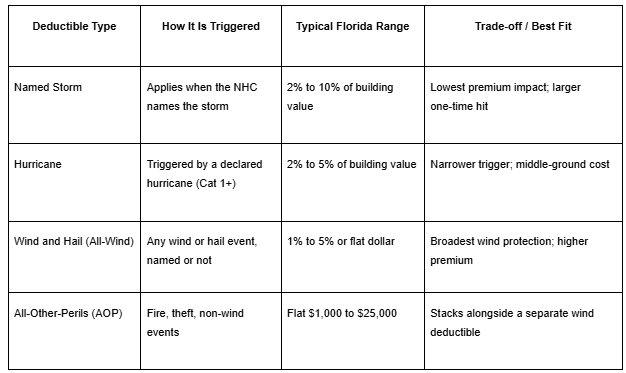
A named storm deductible is a separate, higher deductible that applies only when damage is caused by a storm that the National Hurricane Center has officially named. Unlike your standard all-other-perils (AOP) deductible, which is usually a flat dollar amount ($1,000 to $25,000), named storm deductibles are expressed as a percentage of your building’s insured value. A 3% named storm deductible on a $2 million building means $60,000 out of pocket before coverage kicks in.
How are hurricane and named storm deductibles calculated in Florida?
The deductible is calculated as a percentage of the dwelling or building coverage amount on your policy, not the property’s market value or the cost of the damage. If your building is insured for $5 million and your named storm deductible is 5%, your out-of-pocket is $250,000 before the policy pays. That number is fixed regardless of whether the actual damage is $300,000 or $3 million.
Highlight Box: Storm Deductible Types
Use our Service Center to review your current deductible structure and model the out-of-pocket impact of different percentage options.
Wind, Hail & Coverage Needs by Property Type in Florida
Wind and hail coverage for beachfront and coastal commercial buildings
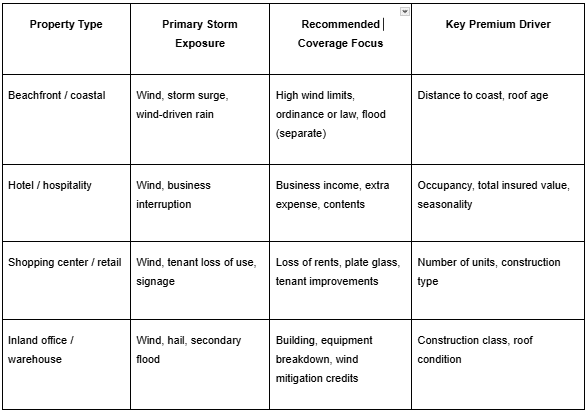
Beachfront properties face the highest wind exposure in Florida and pay the highest premiums as a result. Distance to the coast, whether the building sits within a Wind-Borne Debris Region, roof age, and construction type (masonry versus frame) are the dominant pricing factors. For coastal buildings, ordinance or law coverage is particularly important because post-storm repairs often trigger building code upgrades that can add 20% to 30% to the reconstruction cost.
Business property insurance for hotels facing hurricane exposure
Hotels and hospitality properties face a combination of wind damage risk and business interruption exposure that makes their insurance programs more complex than a typical office or retail building. A hotel that closes for three months of repairs loses not just the building but the revenue stream, and business income coverage with adequate limits and duration is essential. Extra expense coverage (the cost of maintaining operations in an alternative location) adds another layer of protection.
Commercial insurance for Florida shopping centers in storm zones
Shopping centers carry multi-tenant exposure, meaning a single storm event can generate claims across multiple units, common areas, and parking structures simultaneously. Loss of rents coverage protects the landlord’s income when tenants can’t occupy damaged spaces. Plate glass, signage, and tenant improvement coverage address the components most vulnerable to wind damage.
Highlight Box: Coverage Priorities by Property Type
How Much Hurricane Coverage Do Florida Commercial Buildings Need?
The amount of hurricane coverage you need depends on what it would actually cost to rebuild your building at current construction prices, not what you paid for it. Florida construction costs have risen significantly in recent years, and many commercial property owners are underinsured because their coverage limits haven’t kept pace with rebuilding costs.
Is windstorm insurance required for commercial property in Florida?
Windstorm coverage is not mandated by Florida statute for commercial property, but it’s effectively required in most practical situations. Lenders on commercial mortgages almost always require it. Lease agreements with tenants often mandate it. And operating a commercial building in Florida without wind coverage creates financial exposure that most property owners find unacceptable given the state’s hurricane history.
How Much Is Commercial Property Insurance in Florida?
Florida commercial property insurance premiums are among the highest in the country, driven by the state’s concentrated hurricane exposure and the insurance market volatility that follows major storm seasons. Premiums vary widely based on property specifics, but property owners should expect rates that reflect Florida’s unique risk environment.
Why Florida commercial property premiums run high
Seven factors drive Florida commercial property premiums:
-
Roof age and condition (the single largest controllable factor)
-
Construction type (masonry vs frame; concrete block vs wood frame)
-
Proximity to the coast (premiums increase exponentially within a few miles)
-
Total insured value
-
Claims history
-
Wind mitigation features (shutters, impact glass, roof-to-wall connections)
-
Occupancy type and use
Learn how our Florida-based agency works and why local market expertise matters for commercial property pricing.
How to Insure Florida Commercial Property for Hurricane Risk (Step by Step)
Five documents to have ready before requesting a quote:
-
Property appraisal or replacement cost estimate
-
Roof inspection report with age and condition details
-
Loss runs (claims history for the past five years)
-
Wind mitigation report documenting construction features
-
Current declarations page showing existing coverage limits
Which insurers offer hurricane-focused commercial property policies?
Florida’s commercial property market includes admitted carriers, surplus lines carriers, and Citizens Property Insurance (the state’s insurer of last resort). Surplus lines carriers often provide the most competitive terms for high-value or high-exposure commercial properties because they have more underwriting flexibility than admitted carriers.
Harbour Insurance Agency is an independent agency that accesses both admitted and surplus lines markets on behalf of Florida commercial property owners. Talk to a licensed Florida agent to compare options across the full market.
How to Reduce Premiums on Hurricane-Exposed Commercial Buildings
Six premium-reduction levers for Florida commercial property owners:
-
Invest in wind mitigation upgrades (impact windows, reinforced roof connections, hurricane shutters) and document them with a current wind mitigation report.
-
Replace aging roofs before they trigger non-renewal or rate increases.
-
Raise your named storm deductible from 2% to 3% or 5% if you can absorb the higher out-of-pocket.
-
Increase your AOP deductible to reduce the non-wind component of the premium.
-
Bundle property coverage with other commercial lines for multi-policy credits.
-
Implement a risk-management and loss-control plan that demonstrates proactive property maintenance.
The Insurance Institute for Business & Home Safety (IBHS) provides research-based guidance on building resilience and wind mitigation strategies that insurers recognize when pricing commercial property coverage.
Get a tailored quote with mitigation credits applied from Harbour Insurance Agency.
Build Stronger Commercial Property Insurance Florida Businesses Can Rely On with Harbour Insurance Agency
Florida commercial storm coverage is built on three decisions: deductible structure, adequate limits, and separating wind from flood. Getting any one of those wrong can cost you six figures or more in a single storm event. The deductible decision alone deserves careful modeling: a 3% named storm deductible versus a 5% on a $3 million building is a $60,000 difference in out-of-pocket exposure, and that gap should be a deliberate choice, not a default.
Harbour Insurance is a Florida-based, licensed independent agency that compares carriers on behalf of commercial property owners. We model deductible scenarios, verify that coverage limits reflect current construction costs, and structure programs that coordinate property, flood, and business income coverage so nothing falls through the cracks during a storm.
Contact Harbour Insurance Agency to start your quote, or call us at (239) 354-4053 to speak with a licensed Florida commercial insurance specialist.
Frequently Asked Questions About Commercial Property Insurance Florida
Is windstorm insurance required for commercial property in Florida?
Not by state statute, but commercial mortgage lenders almost always require it, and operating without wind coverage in Florida creates financial exposure that most property owners cannot reasonably absorb. It is effectively mandatory for any financed commercial building.
Does a named storm deductible apply per storm or per year?
It depends on the policy. Some Florida commercial property policies apply the named storm deductible per occurrence (per storm), while others use a calendar-year structure where the deductible resets annually. Confirm the trigger and reset provisions in your specific policy.
What is the difference between hurricane and windstorm coverage in Florida?
Hurricane coverage triggers only when the National Hurricane Center declares a hurricane (Category 1 or higher). Windstorm coverage is broader, applying to any wind event including tropical storms and unnamed wind events. Named storm coverage falls in between, triggering for any storm the NHC names.
Can I buy down my Florida hurricane deductible?
Yes. Deductible buy-down options are available from some carriers and allow you to reduce the percentage deductible in exchange for a higher premium. This can be cost-effective for property owners who want to limit out-of-pocket exposure without changing their base coverage.
How quickly can a Florida commercial property policy be issued?
Timing varies by carrier and complexity. Straightforward risks can often be bound within a few days. Complex or high-value properties may require additional underwriting time. Starting the process early, especially before hurricane season, gives you the most options and the best pricing.
Does commercial property insurance cover business income during a hurricane closure?
Yes, if your policy includes business income (also called business interruption) coverage. This pays for lost revenue and continuing expenses while your building is being repaired after a covered loss. Verify that the coverage period is long enough to account for realistic repair timelines in Florida’s post-hurricane contractor market.
Harbour Insurance Agency is an independent Florida insurance agency helping commercial property owners structure hurricane-ready coverage across multiple carriers. Our agents compare deductible options, verify coverage limits, and coordinate property, flood, and business income protection for Florida’s storm-exposed commercial buildings.




