
If you own commercial property and assume your building is covered against flood damage, you’re almost certainly wrong. Standard commercial property insurance policies explicitly exclude flood, and this exclusion applies regardless of your flood zone, your property value, or how comprehensive your policy appears on paper. It’s the single most common and most expensive coverage gap in commercial real estate, and it catches property owners every time a major storm, heavy rainfall event, or rising waterway pushes water into buildings that owners believed were fully insured.
The solution is a dedicated commercial flood insurance policy, available through FEMA’s National Flood Insurance Program (NFIP) or through private flood carriers that offer higher limits and broader coverage. Understanding the gap, the options, and the cost drivers is the difference between recovering from a flood event and absorbing hundreds of thousands of dollars in uninsured damage.
Key Takeaways:
-
Standard commercial property policies exclude flood damage entirely, meaning storm surge, rising water, and surface water accumulation are not covered regardless of how comprehensive the rest of your policy is.
-
Commercial flood insurance comes in two forms: NFIP (government-backed, capped at $500,000 building / $500,000 contents) and private/excess (higher limits, broader coverage, often replacement cost).
-
NFIP does not cover business interruption or lost income during repairs, so commercial property owners who depend on rental income or business revenue need supplemental coverage.
-
There is a standard 30-day waiting period for new NFIP policies, which means buying coverage after a storm is forecast provides no protection. Secure or review flood coverage by April to ensure active policies before peak hurricane season.
-
Properties outside high-risk flood zones still face real flood exposure: almost one-third of NFIP claims from 2014 to 2024 came from areas outside mapped high-risk flood areas.
Not sure where your coverage gap is? Compare your options across our insurance solutions.
Do I Need Flood Insurance If I Have Property Coverage?
Yes. Your commercial property policy covers fire, theft, wind, and many other perils, but it explicitly excludes flood. The exclusion applies to surface water, storm surge, river overflow, and rainfall accumulation that enters the building at ground level. This is not a coverage limitation or a sub-limit; it’s a complete exclusion.
The distinction between covered water damage and excluded flood damage is important. A pipe that bursts inside your building is typically covered under your property policy as an internal water damage event. Water that enters from outside at ground level, whether from a hurricane’s storm surge, a swollen canal, or three days of heavy rain, is flood damage and requires a separate policy.
This gap exists because flood risk is concentrated geographically and temporally, which makes it difficult to price within a standard property policy. The solution is a standalone flood policy that addresses the excluded peril directly.
Business Flood Insurance Explained: How Commercial Flood Coverage Works
Commercial flood insurance is available through two channels, each with different structures, limits, and features.
Highlight Box: Commercial Flood Coverage Options vs a Standard Property Policy
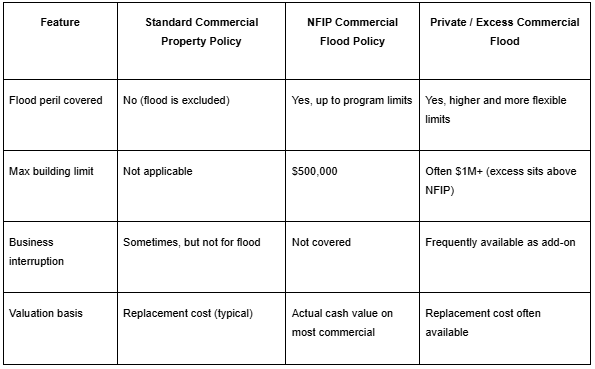
Source: NFIP limits per FEMA. Verify current limits before purchasing.
NFIP policies are federally backed and standardized: the terms are the same regardless of which carrier sells them (through FEMA’s Write Your Own program). Private flood carriers use their own underwriting models, which means pricing, limits, and coverage features vary by carrier and can be more favorable for buildings that rate well under private risk assessment.
The 30-day waiting period for new NFIP policies is important to plan around. Coverage does not take effect for 30 days after purchase, so last-minute buying after a storm is forecast provides no protection. Private carriers typically have shorter waiting periods (10 to 15 days), though some waive the wait entirely for certain transactions.
What Commercial Flood Insurance Covers (and What It Doesn’t)
Typically covered: building structure, foundation, electrical and HVAC systems, permanently installed fixtures, business contents and inventory (with contents coverage), and debris removal.
Typically excluded or limited: lost business income (under NFIP), landscaping and outdoor property, currency and valuable papers, property outside the building, and moisture damage the owner could have prevented with reasonable maintenance.
The business interruption gap is the most significant limitation of NFIP commercial flood policies. If your building floods and you lose three months of rental income or business revenue while repairs are completed, NFIP pays nothing toward that lost income. Private flood carriers and separate business income policies can fill this gap, but only if you’ve arranged the coverage before the event.
Visit our Service Center if you’re a current policyholder managing a claim or needing documentation for a flood-related issue.
Who Needs Commercial Flood Insurance? Coverage by Property Type
Commercial flood insurance for offices and retail properties
Ground-floor offices and retail spaces face contents damage, tenant improvement loss, and operational downtime when flooding occurs. Even buildings outside designated high-risk zones can flood from heavy rainfall, drainage failures, or nearby construction that alters water flow patterns. NFIP provides the base layer, with private coverage adding business interruption and higher contents limits where needed.
Business flood insurance for warehouses in flood-prone zones
Warehouses present a unique flood challenge because they store large volumes of inventory at grade level across a wide footprint. A warehouse in a flood zone can lose millions in stock from a single event. NFIP’s $500,000 contents cap is often insufficient, making excess flood coverage essential for warehouses that hold inventory values above that threshold.
Commercial flood insurance for ground-floor restaurant properties
Restaurants face a combination of equipment loss, buildout damage, and income interruption that makes flood particularly devastating. Commercial kitchen equipment, custom buildouts, and specialized ventilation systems are expensive to replace, and the income lost during a multi-month closure can threaten the business itself. NFIP plus private income protection is the recommended structure.
Business flood insurance for coastal commercial property owners
Coastal properties face storm surge exposure that inland properties don’t, and storm surge is among the most destructive and expensive flood events. Properties near the coast need building limits that reflect the possibility of severe structural damage, contents limits that account for everything inside, and coverage terms that acknowledge surge-specific risk.
Excess commercial flood coverage for high-value business buildings
NFIP caps building coverage at $500,000, which is far below the replacement cost of most commercial buildings. A building with a $2 million replacement cost that carries only NFIP coverage has a $1.5 million gap. Excess flood policies sit on top of NFIP to close that gap, providing additional building limits, replacement cost valuation, and often business interruption coverage that NFIP doesn’t offer.
Highlight Box: Commercial Flood Exposure by Property Type
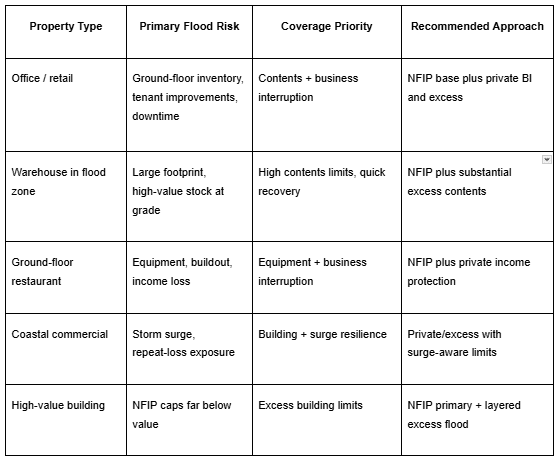
Tell us your property type and we’ll map your exposure. Request a quote from Harbour Insurance Agency.
What Determines Commercial Flood Insurance Premiums for Businesses?
Flood insurance premiums are driven by property-specific risk factors rather than broad geographic averages. Under FEMA’s Risk Rating 2.0, pricing has become more individualized, which means two buildings on the same street can pay very different premiums based on their elevation, construction, and flood history.
Key premium drivers:
-
Flood zone designation and Base Flood Elevation (BFE)
-
Building elevation relative to BFE (documented by an Elevation Certificate)
-
Construction type, age, and number of floors
-
Occupancy and contents value
-
Chosen coverage limits and deductible
-
Loss history and repeat-loss status
For NFIP policies, these factors feed into a standardized pricing algorithm. For private flood carriers, each insurer uses its own proprietary model, which creates pricing variation that makes comparison shopping through an independent agent particularly valuable.
How to Calculate Commercial Flood Coverage Limits for Businesses
Start with your building’s actual replacement cost, not its market value or purchase price. Florida commercial construction costs average $150 to $300+ per square foot depending on the building type and location, so a 10,000-square-foot building could cost $1.5 million to $3 million to rebuild.
NFIP caps building coverage at $500,000 and contents at $500,000. If your replacement cost exceeds those limits (as most commercial buildings do), the gap needs to be filled with excess flood coverage from a private carrier. The excess policy sits on top of the NFIP base and provides additional limits, often with replacement cost valuation and business interruption provisions that NFIP doesn’t include.
How to Buy Commercial Flood Insurance for Your Building
Five steps to securing commercial flood coverage:
-
Identify your flood zone using the FEMA Flood Map Service Center.
-
Order an Elevation Certificate if your property is in a high-risk zone.
-
Determine your building replacement cost and contents value.
-
Compare NFIP and private/excess limits with an independent agent.
-
Bind coverage early to clear the 30-day waiting period before hurricane season.
Lenders on commercial mortgages in Special Flood Hazard Areas (SFHA) require flood insurance as a condition of the loan. Even for properties outside high-risk zones, carrying flood coverage protects against the rainfall and drainage flooding that accounts for a significant share of commercial flood losses nationwide.
The U.S. Small Business Administration provides additional resources on disaster preparedness for commercial property owners.
Learn about our agency and how we help Florida commercial property owners navigate flood coverage decisions. Contact our team to get started.
Close Coverage Gaps with Commercial Flood Insurance from Harbour Insurance Agency
Property policies exclude flood, which makes a dedicated commercial flood policy essential for any building with real flood exposure. The most common and most expensive mistake commercial property owners make is assuming NFIP limits are enough for a high-value or coastal building. They’re not. NFIP caps at $500,000 for building coverage, and most commercial buildings cost significantly more than that to rebuild.
The right approach layers NFIP as the base with excess flood coverage on top to close the gap, then adds business interruption protection that NFIP doesn’t provide. This structure gives you federal backing on the first $500,000 plus the higher limits, replacement cost valuation, and income protection that actually match your building’s value and your revenue exposure.
Confirm your flood zone, calculate the true replacement value, and get a layered quote. Request a quote from Harbour Insurance Agency or call us at (239) 354-4053.
Frequently Asked Questions About Commercial Flood Insurance
How much does commercial flood insurance cost per year?
Cost varies significantly by flood zone, building value, elevation, and construction type. NFIP premiums for commercial properties in high-risk zones can range from several thousand to tens of thousands per year. Private flood may be more or less expensive depending on how the building rates under the carrier’s model. The only reliable way to determine your cost is to get a quote based on your specific property.
What does commercial flood insurance not cover?
NFIP commercial flood policies do not cover lost business income, property outside the building, landscaping, currency and valuable papers, or preventable moisture damage. Private flood policies may cover some of these, but verify the specific terms before purchasing.
Is commercial flood insurance required by law or by lenders?
It is not required by federal law for all businesses, but lenders mandate it for buildings in high-risk flood zones (Special Flood Hazard Areas) with a federally backed mortgage. Even without a lender requirement, carrying flood coverage is strongly recommended for any property with meaningful flood exposure.
What is the difference between NFIP and private commercial flood insurance?
NFIP is the government program with standardized terms and fixed limits ($500,000 building / $500,000 contents). Private and excess flood policies offer higher limits, replacement cost valuation, and business interruption coverage that NFIP doesn’t provide. Most commercial property owners benefit from comparing both options.
How long before commercial flood insurance takes effect?
Most NFIP policies carry a standard 30-day waiting period. Private flood carriers typically have shorter waiting periods of 10 to 15 days. The waiting period is waived when coverage is purchased in connection with a new commercial mortgage.
Harbour Insurance Agency is an independent insurance agency helping commercial property owners close the flood coverage gap. Our agents compare NFIP and private flood options, structure excess coverage for high-value buildings, and coordinate flood protection with property and business income policies across Florida and beyond.




