
Commercial auto insurance covers vehicles owned, leased, hired, or used by a business for business purposes. It is separate from personal auto insurance and provides liability, physical damage, and medical payments coverage designed for commercial use. Also referred to as business auto insurance or commercial vehicle insurance, this coverage is required by law in most states for any vehicle registered to a business or used primarily for business operations.
Harbour Insurance Agency is licensed to write commercial auto policies across multiple states. Explore our business insurance solutions to see how commercial auto fits alongside general liability, workers comp, and property coverage.
Key Takeaways:
-
Commercial auto insurance covers vehicles owned, leased, hired, or used by a business, and it is separate from a personal auto policy that will typically deny claims arising from business use.
-
Core coverages include liability (bodily injury and property damage), physical damage (comprehensive and collision), medical payments, and uninsured/underinsured motorist protection.
-
Hired and non-owned auto (HNOA) coverage protects the business when employees drive rented vehicles or use their personal cars for work, filling a gap that catches many employers off guard.
-
Most small businesses choose a combined single limit; common limits range from $500,000 to $1,000,000, with higher limits available and often required by client contracts.
-
Liability-only policies lower cost but leave your own vehicles unprotected against physical damage.
-
Endorsements such as additional insured, waiver of subrogation, and hired-auto physical damage are often required by contracts and should be built into the policy from the start.
Request a commercial auto quote tailored to your vehicles, drivers, and radius of operation.
What Does Commercial Auto Insurance Cover?
Commercial auto insurance protects your business against financial losses from vehicle-related accidents, injuries, and damage. A standard business auto policy (BAP) includes several coverage components, each addressing a different layer of risk.
Highlight Box: Core Commercial Auto Coverages
The six core coverage components work together:
-
Liability for bodily injury and property damage
-
Collision (physical damage)
-
Comprehensive (physical damage)
-
Hired and non-owned auto (HNOA)
-
Medical payments (MedPay)
-
Uninsured and underinsured motorist
Commercial vs. Personal Auto Insurance: Why the Difference Matters
Personal auto policies typically exclude business use, which means a claim that occurs while an employee is making a delivery, visiting a client site, or running a business errand can be denied under the personal policy. The denial doesn’t just leave the vehicle unrepaired; it leaves the business exposed to the liability claim from the other party, which is where the real financial damage occurs.
The distinction also extends to who is covered. A commercial auto policy can cover multiple drivers, multiple vehicles, and multiple use cases under a single policy. A personal policy covers the named individual and their personal vehicle. If your business involves anyone driving anything for work purposes, a commercial policy is the only structure that reliably covers the exposure.
Our licensed advisors help business owners understand where personal coverage ends and commercial coverage begins.
What Does Hired and Non-Owned Auto Insurance Actually Cover?
Hired and non-owned auto coverage is one of the most important and most misunderstood components of a commercial auto program. It protects your business when employees drive vehicles that the business doesn’t own, which happens far more often than most employers realize.
When your team rents vehicles for work (hired auto)
Hired auto coverage provides liability protection when your employees rent or borrow vehicles for business use. If an employee rents a car for a business trip and causes an accident, the liability claim comes back to the business. Without hired auto coverage, the business has no policy to respond to that claim. Hired auto is liability-focused by default; if you want the rental vehicle itself covered for physical damage, you need a hired-auto physical damage endorsement.
When employees use their personal cars for business (non-owned auto)
Non-owned auto coverage protects the business when employees use their personal vehicles for work errands, client visits, deliveries, or any other business purpose. If that employee causes an accident while driving for work, the injured party can sue both the employee and the employer. Non-owned auto coverage responds to the employer’s liability in that scenario.
One critical distinction: HNOA does not pay to repair the employee’s personal vehicle. That remains the employee’s responsibility under their own personal auto policy. HNOA protects the business against third-party liability claims, not the employee’s property damage.
If your team ever drives vehicles the business doesn’t own, talk through your exposure with our team to make sure you’re covered.
How Much Liability Coverage Should Your Commercial Autos Carry?
Most states set minimum commercial auto liability requirements, but minimums rarely provide adequate protection for a business. A serious accident involving injuries to multiple parties can generate claims well into six or seven figures, and a policy carrying only the state minimum will exhaust its limits quickly, leaving the business responsible for the remainder.
Common liability structures include combined single limit (CSL), where one limit applies to all bodily injury and property damage per accident, and split limits, where separate limits apply to per-person injury, per-accident injury, and property damage. Most small businesses choose a CSL of $500,000 to $1,000,000, with higher limits available for businesses with greater exposure.
The factors that push limits higher include cargo value, number of drivers, radius of operation (local vs. long-haul), contract requirements from clients, and exposure to catastrophic injury claims. The National Association of Insurance Commissioners (NAIC) provides consumer resources on auto insurance and state regulation. For businesses operating interstate commercial vehicles, the Federal Motor Carrier Safety Administration (FMCSA) sets federal minimum insurance requirements.
Commercial Auto Insurance for Small Delivery and Service Fleets
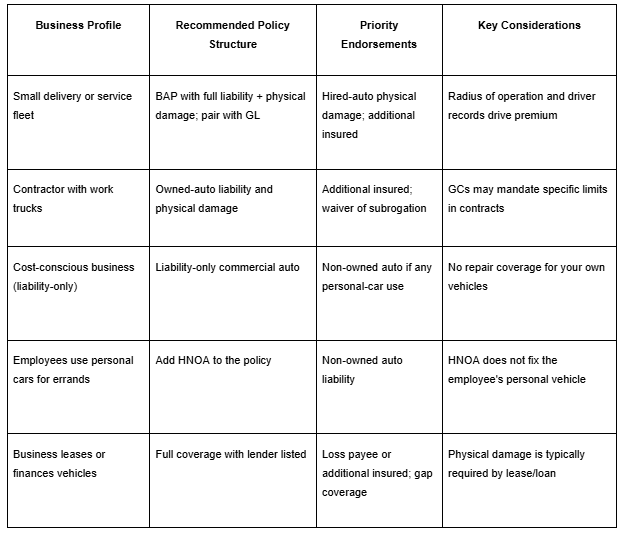
Small fleets (two to ten vehicles making local deliveries or service calls) represent one of the most common commercial auto profiles. These businesses need liability coverage on every vehicle, physical damage coverage on vehicles that are financed, leased, or valuable enough to protect, and HNOA if any employee ever uses a personal vehicle for business.
Pairing commercial auto with general liability is common for small fleets because the two policies cover different exposure categories. Commercial auto covers vehicle-related incidents; general liability covers everything else (premises liability, completed operations, advertising injury). Neither replaces the other, and most client contracts require both.
Highlight Box: Business Scenario to Coverage Fit
Explore our business insurance solutions to see how commercial auto and general liability work together for small fleets.
Commercial Auto Insurance for Contractors Using Work Trucks Daily
Contractors who operate work trucks face specific insurance requirements driven by client contracts, job site access rules, and the nature of the work itself. General contractors frequently require their subcontractors to carry commercial auto with specific limits (often $1,000,000 CSL), additional insured status naming the GC, and a waiver of subrogation preventing the sub’s insurer from pursuing the GC after a claim.
These contract-required endorsements aren’t optional extras; they’re conditions of getting the job. A contractor who can’t provide a certificate of insurance showing the required limits and endorsements doesn’t get on the job site. Building these endorsements into your policy from the start prevents last-minute scrambles when a new contract lands.
Note: this section covers light and medium work trucks used by contractors, trades, and service businesses. Heavy long-haul trucking is a separate class with different regulatory and insurance requirements, including FMCSA filings and MCS-90 endorsements.
Liability-Only vs. Full Coverage: Choosing a Cost-Conscious Structure
A liability-only commercial auto policy covers damage and injuries you cause to others but does not cover damage to your own vehicles. This structure lowers the premium because you’re eliminating the physical damage (comprehensive and collision) component, which can represent 30% to 50% of the total cost depending on vehicle values.
The trade-off is real: if your vehicle is damaged in an accident, stolen, or destroyed by weather, you absorb the full replacement or repair cost out of pocket. For older vehicles with low market value, this may be a reasonable calculation. For newer, financed, or high-value vehicles, it’s usually not, because the lender or lessor will require physical damage coverage anyway.
The decision isn’t between “good coverage” and “cheap coverage.” It’s between paying the insurer to protect your vehicles and paying for vehicle losses yourself. For businesses where the vehicles are the revenue-generating asset (delivery, service, contracting), liability-only is a riskier bet than it appears on the premium comparison alone.
How to Insure Leased and Financed Vehicles Under a Business Auto Policy
Leased and financed vehicles come with insurance requirements set by the lender or lessor. These typically include full physical damage coverage (comprehensive and collision), the lender or lessor listed as loss payee or additional insured on the policy, and potentially gap coverage to cover the difference between the vehicle’s actual cash value and the remaining loan balance if the vehicle is totaled.
If your business leases vehicles, confirm that your policy lists the lessor correctly and includes the physical damage coverage they require. Failing to maintain the required coverage can trigger lease penalties or force-placed insurance from the lessor, which costs more and provides less protection.
Manage a policy change in our Service Center if you need to add a leased vehicle or update your coverage structure.
How Much Does Commercial Auto Insurance Cost?
Commercial auto insurance cost depends on several factors that are specific to your business, which makes broad averages less useful than understanding what drives your particular premium.
Seven factors that determine your commercial auto cost:
-
Number, type, and value of vehicles
-
Driving records and experience of listed drivers
-
How the vehicles are used and the radius of operation
-
Selected liability limits and deductibles
-
Claims history and years in business
-
State, garaging location, and local loss trends
-
Added endorsements and required limits from client contracts
A single work truck with one clean-record driver operating locally will cost significantly less than a fleet of ten vehicles with multiple drivers covering a multi-state territory. The only reliable way to get an accurate figure is to provide your specific vehicle, driver, and usage details.
Request a commercial auto quote from Harbour Insurance Agency for pricing based on your actual operation.
Which Endorsements Are Essential on a Commercial Auto Policy?
Endorsements modify your base policy to address specific exposures or contract requirements. For most commercial auto policyholders, several endorsements are either essential or frequently required by clients.
-
Additional insured: extends liability protection to a client or partner named in a contract.
-
Waiver of subrogation: prevents your insurer from pursuing a party you’ve agreed to hold harmless.
-
Hired-auto physical damage: covers repair costs for rented vehicles your team drives.
-
Drive other car (DOC): protects owners or executives driving vehicles they don’t own.
-
Lease or loan gap: covers the balance owed if a financed vehicle is totaled beyond its actual cash value.
-
Non-owned auto liability: protects the business when employees use personal cars for work.
Building these into the policy from the start is less expensive and less disruptive than adding them one at a time when contracts demand them. Manage endorsements through our Service Center or contact us to review what your current policy includes.
Do You Need Commercial Auto Insurance?
If any of the following apply to your business, you likely need a commercial auto policy:
-
You own, lease, or rent vehicles in the business name.
-
Employees drive for deliveries, service calls, or client visits.
-
You haul tools, equipment, or goods.
-
A vehicle is registered to the business or carries commercial plates.
-
A client contract requires proof of commercial auto coverage.
-
Employees regularly use personal cars for work errands.
If you checked even one of those boxes, a conversation about commercial auto coverage is worth having. Talk through your exposure with our team or call (239) 354-4053.
Protect Your Fleet with Commercial Auto Insurance from Harbour Insurance Agency
The right commercial auto policy is built around real vehicle use, driver exposure, and contract requirements, not the lowest premium on a comparison sheet. Three things matter most: carrying adequate liability limits that protect the business against a serious accident, adding HNOA coverage whenever employees drive vehicles the business doesn’t own, and building contract-required endorsements into the policy before you need them rather than scrambling after a client asks for a certificate.
Harbour Insurance is an independent agency that compares commercial auto options across multiple carriers. We help businesses right-size their limits, structure endorsements for contract compliance, and find competitive pricing without sacrificing the coverage that actually protects the operation.
Request a commercial auto quote or talk to a Harbour advisor today. You can also call us directly at (239) 354-4053.
Frequently Asked Questions About Commercial Auto Insurance
Is commercial auto insurance tax deductible?
Yes, in most cases. Commercial auto insurance premiums are generally deductible as an ordinary and necessary business expense. Consult a tax professional for guidance specific to your situation, and refer to IRS Publication 463 for details on business vehicle expenses.
How fast can I get a commercial auto insurance certificate?
A certificate of insurance (COI) is typically available within hours once a policy is bound. If you need proof of coverage for a contract deadline or job site requirement, contact our Service Center and we can expedite the process.
Does a business owner’s policy (BOP) include commercial auto?
No. A standard BOP bundles general liability and commercial property but does not include auto coverage. Commercial auto is a separate policy that pairs with your BOP or standalone GL to cover vehicle-related exposures.
Can I add commercial auto coverage to an existing business policy?
Yes. Commercial auto can often be coordinated with your existing general liability, property, and umbrella policies under a single renewal date for simplified administration. Explore our insurance solutions to see how bundling works.
What limits do most contracts require for commercial auto?
A $1,000,000 combined single limit is the most common contractual requirement, though specific limits vary by client, industry, and project scope. Some contracts also require specific endorsements like additional insured and waiver of subrogation.
Will commercial auto insurance cover an employee’s DUI or an unlisted driver?
Coverage can be limited or denied for excluded or unlisted drivers and for serious violations like DUI. Accurate driver scheduling and prompt reporting of new drivers to your carrier are essential to maintaining reliable coverage.
Harbour Insurance Agency is an independent insurance agency helping businesses structure commercial auto coverage across multiple carriers. Our agents compare liability limits, endorsements, and pricing to build policies that match how your vehicles are actually used.




